Tuesday, 18 October 2016

Physical theatre research

The Oxford dictionary definition of physical theatre is ‘A form of theatre which emphasizes the use of physical movement, as in dance and mime, for expression.’ Although simply put, this definition is correct for most performances in the style of physical theatre. Commonly, pieces of theatre in this genre usually place more emphasis on movement rather than dialogue. However, there are a huge number of variations in this particular genre. The style itself covers a broad range of work and because of this, there are many different styles of physical theatre itself. Essentially, at its simplest, physical theatre is anything that puts the human body in the middle of the storytelling process. As a result of this, physical theatre is usually abstract in nature and uses movements in a stylised yet representational way. The expression of ideas and concepts are choreographed in a physical way, so many performers have little or no dialogue at all. 

Techniques:
Physical theatre cleverly adapts performances so that they are rife with innovative, interesting visuals. However, many earlier plays in this genre show us that relying solely on such visuals may create an exciting, yet confusing production. Because of this, it is important to create an interesting play, which has some informative dialect. For example, it is almost impossible to say that someone is a sister or a family member through dance, so some dialogue is needed.  This is where many of the techniques used in physical theatre come in. These techniques focus on how to use your body to create a story that can be easily viewed by the audience.

Mime:
Mime is commonly used in physical theatre. It is the technique of suggesting action, character or emotions without using words. It can also be used in physical theatre to mime props or even pieces of set. For example, mime could be used to recreate the motion of a car or a bus. Mime originated from early ancient Greece but is in no way dated or boring. Many imagine mime as French street performers doing a stereotypical ‘imaginary box’ sequence. However, when used in physical theatre, mime is visually stunning and is the basis of many amazing sequences of dance and performances.

Status:
Portraying a person’s status using physical theatre can add to a performance in ways that simply using dialogue cannot.  Rather than adding titles or names to a character which imply status, many performances in this genre choose to use different levels, distance or strength to portray a natural hierarchy within the characters. Mixed with dialogue, this technique is used in many physical theatre productions as it is simplistic but clearly shows the audience the change in status throughout the play.

Gesture:
To portray information through movement is the basis of physical theatre. Because of this, gesture is naturally a technique widely used in productions. It can be subtle but can still produce emotional impact, or it can be a movement that defines a character. Even subtle gestures add to the emotion and depth of the play. For example, if a character was to shy away from another, the audience would automatically assume that something had happened to create this fear, even if we haven’t directly seen this altercation.

Proximity:
Proximity means how close the actors are on the stage. Similarly to gesture, this can be used subtly to create a powerful impact upon the audience. For example, literal closeness can portray emotional closeness between characters. This is an effective way to show backstory without having to literally show the characters past.

Stance:
Stance is associated with strength and power and the body can radiate authority with a simple change in posture. Similarly, the body can radiate a huge range of emotion and status through the stance and posture of a character.

Movement:
Although it seems obvious, all movements in physical theatre must be precisely rehearsed. A particular lift or sequence may rely on a small movement, so all movements must be carefully rehearsed.

Not moving:
If the stage is full of characters moving, immobility can have a huge effect upon the play.

Mask work:
Many performances in this genre choose to have scenes or plays that focus on using masks to add emphasis on vocals or movements. Because of this, many groups choose to rehearse with the use of mask work, even if they do not incorporate it into their final performance. It is largely used in performance because it makes actors think thoroughly about how the facial features largely produce emotion. This aids the movements and vocalisation of a character as it allows the actors to focus upon how these aspects of acting.

Dance work:
Because of its nature, many people link physical theatre to dance. However, many movements and sequences do not include dance as such. Many lifts and movements are naturally connected to more traditional forms of dance, but a large part of such performance do not connect with dance and may be stand-alone movements, created specifically for the performance. On the other hand, many companies choose to embrace this connection and produce beautiful sequences of dance within their performances.

Motif:
Motif is the repeated use of a movement throughout the play. This has meaning for the story and helps to remind us the central theme of the work. In more traditional theatrical performances, motif can be a repeated sound or line. 

Brecht research

Background:

Born in 1898, Bertolt Brecht originated in a small German town called Augsburg, where he spent his childhood years. Married in 1897, his parents were of differing religions (his father was a Catholic and his mother was a Protestant) however still decided to get a young Brecht baptised. Brecht was their first son and was baptised as Eugen Bertolt Friedrich Brecht. Later in 1900, they had another child, Brecht’s brother, Walter.

Health issues:

As a child, Brecht was regularly ill and struggled with health issues. He had a congenital heart condition and a facial tic. Because of this, he was sent to a sanatorium in order to calm himself down. Although this was beneficial for his health, at the age of twelve, Brecht had a heart attack. He soon recovered and continued with his education.

Education:

At the age of six, Brecht attended a Protestant-run elementary school. After he completed this school, he then attended a private school where he was educated in Humanities and Latin. This part of his life had large significance to his later pieces of work. This is because, at this young age he was introduced to the German translation of the Bible. Many references and quotes from this text can be found throughout Brecht’s work, particularly in pieces such as- ‘Mother Courage and Her Children’. During his time at school, he began writing many pieces and ended up co-founding and editing a school magazine. By his mid teenage years, Brecht was writing for a local newspaper and had written the first of his many plays- aptly named ‘The Bible’. Although he excelled at school, at age eighteen, he was nearly expelled for disagreeing about it being mandatory to defend his country at war. After this, he left school at nineteen and had begun doing clerical work for the war that he disagreed with. However, he was forced to stop this work due to health problems.
Due to this, in 1917, Brecht returned to his education and attended a University in Munich, where he studied medicine. However, the war had had life-long effects on Brecht. Because of this, he decided to dedicate a larger part of his life to theatre and play writing. Throughout 1921, he took many trips to Berlin and attended many rehearsals of popular plays and productions. Throughout 1922, his play ‘Drums in the Night’ premiered in Munich and then later, in Berlin. As a result Brecht earnt his first award for his work- he received the prestigious Kleist prize for young dramatists.
Brecht’s plays and writings hugely show the influence of Brecht’s later studies. In the remaining years of his life, he studied many different kinds of theatre. He focused on Chinese, Japanese and Indian theatre. Also, he showed a great interest towards Shakespeare’s work and other Elizabethan plays. Furthermore, he found large inspiration in Greek playwrights and German dramatists.

Relationships:

Brecht’s sexual relationships with others has fascinated historians and playwrights alike. During his adulthood, he was thought to have had no less than three mistresses at any time. By the age of sixteen, Brecht began to frequently visit a brothel in order to broaden his experiences. After this age, he supposedly began to pursue eight different girls simultaneously. One of these girls was Paula Banholzer, who was the mother of his illegitimate child in 1919. He was known to have experimented with homosexuality and he had stated in his diary the need for both male and female companions.
During 1922, Brecht entered his first fully committed relationship- he married opera singer Marianne Zoff. They had a secure, happy marriage primarily and a year later, their daughter Hanne was born. However, throughout her early years, Brecht had several affairs and spent little time with his wife or daughter. His love of theatre drove him to move to Berlin where he met Helene Weigel- a communist actress. Because of his many affairs with this woman, Marianne moved away from Brecht and began to live with her parents. She stopped corresponding with Brecht completely. At the age of twenty-six, he fathered his second illegitimate son with Weigel. Their child was named Stefan. Because of their relationship and child, Brecht divorced Marianne in order to marry Weigel in 1929.
During 1930, Helene Weigel gave birth to their daughter- Barbara. However, although they had two children, Brecht was definitely not monogamous. There were many more woman in his life and they were largely important for his later pieces of writing. Many of his mistresses even wrote pieces in several of his plays. Weigel was largely tolerant towards his affairs, even when he had a third illegitimate child in 1944. Although Brecht appeared content in his home in Berlin, he was forced to move Zurich in 1933 with his family. He later had to move around the world in order to escape the Nazi rule over Germany.

Brecht’s final moments:

In August 14, 1956, Brecht died of a heart attack. He provided some rather unusual instructions for his dead body: he wished that a stiletto would be placed in his heart and that he would be buried in a steel coffin in order to keep away worms.


Epic Theatre:

Primarily, Brecht experimented with many techniques, such as: Dadaism (A movement that originated during World War 1, where artists showed their disgust about propaganda being spread. Disturbing images were displayed to show this disgust) and expressionism. But he soon begun to develop a unique style that was tailored for his own vision. He hated particular dramas where the audience was made to sympathise with the hero and not analyse his flaws thoroughly enough. He believed that this was a waste of audience. He believed that when the audience was forced to feel, they did not think adequately about what was truly going on in the play. He famously stated that the naturalistic natures of such plays made the audiences “Hang up their brains with their hats in the cloakroom”.
In naturalistic plays or dramatic theatre, the audience is allowed to forget their lives and simply care more about the characters on stage rather than any deeper meaning behind the play. When an audience shows great emotion for a character it’s called catharsis. Personally, Brecht despised catharsis theatre. Due to such emotional investment from the audience, he believed that they lost their ability to judge objectively and to think about the play in front of them.  His belief was that audiences should remain distant from the emotional attachments that the play presented them with, so they could make rational judgements about the issues presented in his work.
To create this feel within the audience, Brecht used many theatrical techniques throughout his productions. These were used to remind the audience that they were really only observers upon the drama, and were not a part of it. His depiction of theatre was called Epic Theatre.
Epic theatre was so different to dramatic theatre in many ways. Dramatic theatre has a strict plot, at the theatre, the story is laid out for us from beginning to end, where all the issues are resolved. However, epic theatre has little of this tidiness. It finishes leaving stories unresolved and questions unanswered. This leaved the audience full of questions and queries about the issue addressed in the play. Usually, epic theatre was an inspiration to the audience. Brecht believed that dramatic theatre was just entertainment and thought that it only emotionally effected the viewers and remained with them only for their time in the theatre.

Techniques:

Alienation:
Brecht’s most well-known and most used dramatic technique was the technique of alienation towards the audience. Brechtian theatre uses alienation in many ways. He uses alienation to simply get the deeper message across to the audience, without getting them invested in any unnecessary, distracting emotional ties. Epic theatre commonly breaks the fourth wall to make the play more interactive towards the audience. This makes them active members rather than just observers, this ultimately makes them think more, which is Brecht’s final aim. There are many different techniques which are used within alienation to create a wider thinking audience. For example:

Coming out of character:
Usually a technique shunned by many other practitioners, coming out of character means simply saying or doing something that your character would not. You may revert back to your own personal traits, or simply forget lines. However, Brecht uses this technique skilfully. He uses the character break to remind the audience of the theatrical manner of his plays. This reminds them that they are not watching real life and are simply watching a production. For example, midway through a scene, an actor may break character to remark upon his characters feeling or intentions. This is beneficial towards Brecht’s Epic Theatre as it still portrays these emotions and interactions successfully to the audience, yet it still reminds them that it is not real.

Narration:
Similarly to breaking character, narration is used to remind the audience that they are simply watching a presentation of the story, rather than being part of the story themselves. Plays without such narration make it easier for the audience to feel closer and more connected with the story and its characters. This may appear beneficial, but remember that Brecht wishes for a more intellectual view after the play, not an emotional one. Sometimes, many plays will narrate at the beginning and may even tell the audience what is going to happen (although not necessarily alienation, Shakespeare’s Romeo and Juliet narrated the ending of the play before the characters are even introduced). This is an interesting way of making sure that the audience doesn’t get emotionally involved with the story and the characters- as we already know the outcome of the play.

Placards:
A placard is an additional prop that is presented onstage. It is a piece of written information for the audience to read themselves. They could be as simple as holding up a banner or a card. In more modern plays, PowerPoint or Microsoft presentations can also be used to the same effect. The information on the placard is usually informative and tells the audience something they didn’t know. The information must also deepen our understanding upon the play and its characters. For example, the musical ‘Miss Saigon’ used a slideshow to effectively demonstrate the loss of lives in the Vietnam War. This was effective as it primarily introduced many unseen themes that run throughout the play. It did not simply comment upon the war itself, but deepened our understanding of how the War killed thousands and of the social and political issues that came with war.

Furthermore, if a placard was being used to let the audience further interpret a character, it must not simply say what they are feeling. Their feelings would be shown from the acting and a placard stating how they were feeling would tell the audience something that they already knew. Instead, placards are used effectively to portray a character when they tell the audience otherwise unknown pieces of information about the character. This may be the cause of their emotion or some information to help the audience form a more informed viewpoint about the characters.

Speaking the stage directions aloud:
This particular technique was used more in rehearsals rather than in actual plays. It was frequently used in rehearsals to remind the actors that they must distance themselves from their character. It reminded both the audience and the actors that they are simply watching/creating a play. This helps to make the audience further analyse the actions of a character in a more objective detail.

Direct address:
Direct address is where an actor speaks directly to a person in the audience. This is a common break of the fourth wall and is used in many styles of theatre as it can provide a more comical side of a play. This technique can be used to make the audience feel closer to the characters and action. However, naturalistic plays would usually never use fourth wall breaks.

All of these techniques are included in the wider theatre technique of Alienation. This is because they simply alienate the audience. The audience would most likely not expect any such techniques to occur, so feel confused and bemused towards the nature of the play. Although many playwrights portray confusion from the audience as a bad thing, Brecht uses this confusion to make the audience think about what is going on throughout the play.

Brechtian staging:

Multi-roling:
Multi-roling is where an actor plays more than one different characters onstage. The different characters may be shown in the way the actor moves and acts for each character. They could lower their voice, change their body language and gesticulate differently. A costume change may also be used to present the change of character easily. However, it must still be prominent that the same actor is playing multiple characters. Because of this costume change must be to a minimum and perhaps one or two significant garments change, but no more as this may obscure the view of the actor. The audience can clearly see that an actor has taken on more than one role which makes them more aware that they are watching a presentation of events.

Split-role:
This is nearly the opposite of multi-roling. Split-roling is where more than one actor plays the same character. For example, the main character may have a few actors who rotate their roles after each scene. This effectively inhibits the audience from getting an emotional bond with this character as they are only being represented by actors and are not real people. It stops emotional attachment upon characters which further allows the audience to truly think about the plays meaning itself, rather than being caught up with emotional views.  

Minimal costume/set/props:
Due to the nature of Brechtian theatre, set, costume and props are all kept simplistic and representational. A more interesting, elaborate costume or set may create a more natural feel and may lose the sense of theatre rather than real life. A more empty stage still shows the audience that they are simply being presented events rather than watching television. Although Brecht did not commonly use complex props, there have been examples of some props becoming a ‘member of the family’. These props may be more important than some of the characters in his plays. Such a complex prop would simply be used for authenticity. 

Lighting:
Brecht believed in keeping the lighting as simple as the set. He did not want the lighting effects to overshadow the true meaning of the play. Usually, he commonly used harsh light as he thought it “Illuminates the truth”. He wanted every part of the production to be seen and often, the audience will see the production personnel in action on the stage rather than hidden. This is unusual as most production crews stay unseen to make sure the illusion of naturalism remains intact. Brecht however, thought that if the audience viewed the crews, it would further cement the belief that they were being shown a production rather than being invested in one.

Symbolic props:
There are many examples of props being used in various ways. Similarly to multi-roling, re-using props for different items shows the audience that this is simply a production. A suitcase may become a table or a podium etc. This further shows the audience that they are being presented with events.

Other Brechtian devices:

Song and Dance:
This is a more unusual technique employed by Brecht. However, it is an effective way of alienating the audience. It fully shows the audience that they are watching theatre as such a song and dance would not seem natural in any way. Commonly in Brechtian theatre, the lyrics juxtapose the style of the music itself. The lyrics could be dark and have a more sinister tone to them. However, the music itself may be upbeat and happy. This is effective as it further distances the audience form the characters. A very famous line from his work is “Who is the bigger criminal: he who robs a bank or he who founds one?”. This line would have been sung over a more upbeat arrangement of music. This encourages the audience to listen carefully and truly understand the meaning of the song and dance piece.
Montage:
In the modern era, montage is a phrase that is more readily associated with cinema than theatre. However, in the past, montage was more related to theatre and film together. Brecht consciously borrowed the idea of such montage from silent movies. Many of Brecht’s plays were influenced by montage and used this technique in several areas. Similarly to a cinematic montage, a theatrical montage is a series of small, self-contained scenes that have been immediately grouped one after another. They commonly use juxtaposition to further highlight the issues with clarity and understanding. They are similarly used as montages in films nowadays, they can also allow for the audience to focus on more minute details in the play.
Brecht was largely influenced by a film director- ‘Sergei Eisenstein’. This director had many classic examples of montage in film, however, Brecht was most interested in the ‘Odessa Steps’ sequence in Eisenstein’s famous 1925 film, ‘Battleship Potemkin’. This famous sequence depicted a runaway baby carriage hurtling down a steep set of stairs. Eisenstein effectively uses montage to create a suspenseful atmosphere.
Spass and Gestus:
Spass:
‘Spass’ is a German word which literally translates into English as ‘fun’. Brecht’s ultimate goal was to make his audiences to think more thoroughly. He later realised that laughter also evoked thought throughout theatre. Because of this, Brecht created a new technique called ‘Spass’- the use of comedy to create further interest and thought from the audience. Although a lot of his performances had a rather dark tone and topic, Brecht realised that comedy was an effective way of engaging the audience and forcing them to think about the issues arisen in the plays. According to his theory, even dark and meaningful theatre could benefit from moments of comedy.
Furthermore, Spass was also an effective way to break the tension in more serious scenes. As tension rises in plays, the audience naturally feels more attached to the characters and the story. However, Brechtian theatre dictates that the audience should not feel attached to the characters as it would draw away from the plays main themes. Because of this, Brecht needed to find an effective way of breaking the tension to stop the audience from following the story closely. Spass turned out to be an excellent way to do so. It may be in the form of a comical song, physical comedy, slapstick or even a stand-up routine. Because of the comedic nature, Spass may appear rather silly to the audience. However, it often makes a strong comment upon the social issue that it is based upon. For example, Spass may use black comedy to make the audience laugh at many serious topics. This is very effective as the audience will laugh because of the comedic nature, then they will question why they laughed. This will create controversy which will further make the audience think deeply about the issues brought up in the play.
Gestus:
Another Brechtian technique that is commonly used in Brechtian theatre is ‘Gestus’. This is a clear character movement or gesture that simply captures the moment or attitude rather than delving into emotion. According to Gestus, every single motion and gesture was important. To focus upon this idea, Brecht and his cast closely studied photographs of his plays to ensure that each movement was effective and clear. They wanted to make sure that each gesture was so clear that the audience could understand the story by the gestures alone.
Because of the abstract nature of his plays, Brecht did not want his actors to become a character onstage. Instead, he wished for them to simply portray them as a type of person, rather than a specific person. His characters in the plays are largely stereotypically representative of all real life people. For example, a corrupt boss who smokes a cigar whilst his workers starve represents all bosses who benefit through the exploitation of others. Because of this, Brecht commonly refers to his characters by standard name, such as- ‘The Boy’ or ‘The Doctor’. The audience will interpret the character through their social role. This aids them to understand the character instead of feel an emotional attachment towards them. Because of this, it is far easier for the audience to judge the character rather than empathising with them.


Gestus is not just focusing on the gesture itself, but the social connotation of such a gesture. For example, a soldier marching and saluting across the stage is simply a gesture. However, if he was doing so while marching across a stage strewn with dead bodies, it would be a Gestus as a comment upon what kind of person he represents. 

Thursday, 13 October 2016

Units and objectives for our own monologues.

This lesson was based upon units, objectives and subtext for our own monologues. To begin with, we took a copy of our monologues and split it into units where we felt necessary. I believe that my monologue has four different units. Although  there are only three paragraphs, I think that the second paragraph can be split into two different objectives. This is because; there is a clear shift in my character's mentality and her objective and mood changes drastically.

Moreover, then we had to think of an objective for each unit. An example of an objective is: for my second unit- "Trying to tell us why she's flustered". This is what she is trying to do throughout this unit. At first, she enters very rushed and flustered and she is trying to calm herself down, whilst explaining to the audience why it is that she's flustered in the first place.
 
Next, we had to add in action phrases to our units. These are similar to our objectives as they show what the is doing and explains why they're doing it, however, these are short phrases or single words which explain her objective. An example of auctioning in my monologue is for my second unit. The auctioning is "I trust you". I can interpret this as my character is telling the audience about her day. There appears to be a level of trust between the audience and my character as she doesn't hold back, and tells the audience all of the details of her experience.

Then, we next took our monologues and thought about the subtext in each line. With this information, we 'rewrote' our monologues with only subtext. Then we had to perform them with our sub textual rewrite. My character became more truthful and less filtered an it became more naturalistic. Rather than telling slight lies, she told the exact truth. An example of this is when she states that she wants to go to the museum. When she says it originally, she states it plainly but in subtext, she states that she just wants to see the pretty colours.

Finally, we then took our monologue and performed it with our objectives in. When we came to a new objective, we broke character and said our objective. Then we continued in character and finished our objectives. This was effective as it showed the audience clearly what our objectives and units were. Also, it helped us as actors to clearly understand our scenes as we could see the clear change between objectives and units.

Overall, I believe that this lesson was beneficial because it made my monologue clearer for me. I could obviously see each unit which helped me to understand my characters emotions and objectives.

Tuesday, 4 October 2016

Breakfast short improvisation.

Primarily, at the beginning of this lesson, we had to create a short improvisation. We were given two characters to portray- one who wanted to go on holiday with her other half, and the other half, who wanted to break up. We had to create a small scene portraying these characters and how they acted around each other. However, we were only allowed to talk about breakfast, and nothing else. This was particularly difficult as we had to portray how each character was feeling, without actually saying how they were feeling.

Throughout this short scene, I was the person who wanted to go on holiday and Sophie was the person who didn't want to. Another small difficulty was that we had an extra person in our group, so had to work them into the scene. We added our third person as our slightly creepy roommate. Although we could only speak about breakfast, I believe that we effectively portrayed the relationship between the characters. My character started talking about breakfast in other countries and slowly inched closer to Sophie, until I was nearly on her lap, with my head resting on her shoulder. However, every time I asked a question, she would answer with short negative statements.

I believe that our portrayal was effective as it showed the audience the relationship between the two characters. Moreover, I believe that this exercise was effective as it made us think about our lines carefully, as we couldn't go off topic. However, this was rather difficult as we went off topic a few times and had to try and stop talking about things that weren't breakfast. Overall, I believe that this made me think more about the importance about each line in my monologue, and about how each line matters in its own way.

Units and objectives.

At the start of this lesson, we were given this short duologue:

"Hi.
 Hi
 How are you?
 Fine. You?
Yeah, ok. Maybe see you later?
Yeah might catch up later.
See you then.
Yeah, bye."

We were then told to perform this with a partner. However, we had to thoroughly think about or characters and how they knew each other. Moreover, we had to use subtext to try and create a context for our audience to pick up on. When we had performed our short, the audience had to guess what the characters relationship was and their own personal objectives.

Originally, my short duologue was supposed to revolve around a celebrity and a mega-fan. person A (who had the first, and every other line), was supposed to be this mega-fan who was almost stalking the celebrity (person B). We tried to perform and show this unusual relationship, however, whenever we performed it almost appeared too unfamiliar- the celebrity would be more used to fans. Because of this, we decided to perform it slightly differently:

The beginning was mostly similar, person A leapt out and started hugging and obsessing over person B. However, towards the end of this scene, person A actually stole person B's phone. This added a different spin to the scene as it more clearly showed our relationship (we were complete strangers, but A was feigning a relationship in order to get closer) and it also added our characters objectives. A's objective was to steal B's phone and B's objective was to get away from A. Because of the length of the script, we were unable to truly see a super-objective and we could only interpret the context.

Finally, when we performed. we decided that our piece had three small units in them:
The beginning, when A was hugging and creeping up on B. The middle, where the two had an awkwardly one-sided conversation. And the end, when the audience realise that A has stolen B's phone.

Monday, 3 October 2016

Terminology

Context:
The context is the background for the play or scene. It may not be written into the play but can still be clearly interpreted.

Subtext:
Subtext is the unspoken thoughts and emotions of a character. Subtext isn't portrayed by the text, but by the actors themselves.

Units:
A unit is a section from a text. They are not necessarily paragraphed, but are the sections where the character changes their objective, or the feel of the scene changes. For example, I think my monologue has three (it may be interpreted as four) different units. At first, my character is flustered and nervous- this is one unit. When my character calms down, the scene has a different feel and her objective changes, so this is another unit. Usually, the units are split by a change in objective:

Objectives:
An objective is what the character wants and is trying to do throughout a unit. These may large- i.e. trying to propose, or small- trying to tie their shoe.  When a character has completed their objective or simply changed what they want, a new unit begins and they have a new objective. It is the reasoning behind each action carried out by an actor. If you're an actor and your movements don't have an objective, then are they really necessary?

Super objectives:
A characters overriding desire is usually referred to as a super objective (otherwise known as a motor). This is usually what they want most throughout the whole play, but it can be isolated to scenes and acts. A characters objectives are usually linked into obtaining their super objective.

Action phrases (actioning):
This is adding a verb to a line or unit. It explains the characters objectives and motion in one or two words.

Thursday, 29 September 2016

Monologue editing.

Throughout this lesson we focused on editing our monologues. To begin with, we took a copy of our own monologues and deleted any words which weren't verbs or adjectives. This is what mine was reduced to:

'deal  tried buy  standing  front reach a while,  move, looking taking real long , reading   a pretty boring ask  waited long move,  thought asking move, stupid sensed  needed awful fear ask say move goddam nagging 
 to cry, quietly,softly sobbing, stupid grasp reached brought real hard screamed: kindly move asshole!!!”
fell totally startled, cry, shouted crying drawing attention.'

Primarily, this was quite a difficult thing to do as there was a lot of text to go through, but I got the hang of it in the end. I then performed my monologue in it's reduced version. Although a huge part of the text was gone, it still kind of made sense to those watching. This beginning exercise was effective as it showed me that 30/70% of a text can be whatever we make of it- it can be reduced hugely and still remain understandable. This links into my drama reinterpretation as we need to take 30/70% of a text to devise our performances form.
Furthermore, as well as linking to my later performances it helped me to see that everything matters in my monologue and it also helped me to understand my characters honest, thoughts and objectives. Stripping it back to its simplest was effective as it helped me to see my characters objectives in each line, which helps me to understand what my character truly wants.

Finally, towards the end of the lesson, we decided to do a different exercise with other people's monologues. I took Fiona's monologue, which was from 'After Juliet', and was told to reinterpret the meaning. I edited particular words and sentences in her monologue to change the meaning. This also linked into our reinterpretations as I kept some of the original text and edited or removed the rest.
This monologue is about Rosaline (who was in love with Romeo in Shakespeare's classic- 'Romeo and Juliet'), she speaks about how betrayed she feels after the death of Romeo. The monologue takes a more aggressive tone as she is angry towards her cousin, Juliet, for killing her love.
However, my task was to change the meaning of the monologue, so rather than being angry, I made the tone sad and obsessive. Rather than showing hatred towards Juliet, I made her seem almost in love with Juliet. I changed many lines to almost say the opposite of what she means and overall made her appear in grief from Juliet's passing and not Romeo's.
Overall, this exercise was effective as it showed me how little or how much I can include in my reinterpretation. Even if I keep a large amount of the original lines, I can still change the tone and meaning hugely.

Sunday, 25 September 2016

Vocal lesson.

As we had previously focused on our movements, we decided to focus on our vocals for this lesson. We decided to continue focusing on our character from our monologues. Although we all had learnt our monologues fully, a lot of us realised that we didn't truly understand our characters- we didn't have a clear 'voice' for them inside our heads. Because of this, we decided to focus on our characters and tried to create a deeper understanding of how they speak and think.

To do this, we split off into groups of 3 and one by one, told the others who our characters were and how we originally felt the spoke. Originally, I believed that my character was well-spoken and was brought up well. I thought this because; although h my character has mental-health issues, she never addresses them and they are almost not spoken of. Throughout the play, we see her decline into a deeper state of illness, however, she never addresses her illness and doesn't seek out a doctor or help for her state. Moreover, I believe that she is was taught as a child to be well-spoken. I think this because she seems to use curse words as a 'last resort' . Se only uses them when absolutely necessary, and her 'worst' swear word is- 'bitch'. Also, even when she is extremely distressed, she still remains polite and well-spoken. Because of these factors, I believe that me character is rather 'posh' and had a traditional upbringing.

I told my group this and we all agreed on her upbringing. However, my group had the idea that I could perhaps play with the idea of my character having an accent. The accent in particular would be upper class, Australian. Although I struggle doing accents, I tried to vocalise this specific accent. To do this, I listened to recordings of the Australian accent and focused on how different it was from mine. Whilst doing this, I realised that there are many slight differences between the accents themselves. For example, Australians appear to speak at a much faster pace and also 'drop' vowels and letters to increase the speed of their conversations.

I took all of this into consideration and attempted an Australian accent with my character. Although I like the effect it had on my character (it made her seem more nervous and made my monologue more interesting), I am not very good at the accent itself and believe that it wasn't very believable. However,  I will continue to try and develop this accent. For now, my character remains a well-spoken, upper classed Brit.

Overall, I believe that this technique was effective as it made me think about my character and her voice in more detail. I fell like I know and understand my character more now.

Love and information.

We decided in this lesson to begin to read one of our exam plays- Love and Information. We read the first Act and delegated characters to people in our class. This in itself was harder than first imagined, as the play doesn't actually have scripted characters or lines. Because of this, we decided to alternate lines between two people every scene. I thought that this was effective as most of  the scenes are quite short and only really need two characters. Later on, we may decide to incorporate a larger cast in the scenes but I believe that, for now, this idea was effective.

Whilst reading the first few scenes, we realised that Love and Information is written in a very unique way: there are no characters scripted and the lines are set out like a large monologue. Also, there was little punctuation and most of the lines relied on enjambment and continued onto the next line. Moreover, there were little stage directions or set present in the text. Although unusual, I like the way Love and Information is written as it is widely open to interpretation. For example, there could be as many actors as we needed as there are no particular scripted lines- we could have as little as three actors or as many as 100. Furthermore, another aspect of the play that is open to interpretation is the set design.

Throughout this lesson, we focused mainly on this aspect of the play and decided to imagine what set we would use if we were doing a production of the play. First of all, we had to review a few practical considerations:
  • There are 57 scene changes but the characters don't enter or exit during the scenes.
  • There is a maximum of 100 characters.
  • The play is divided into 7 sections.
  • The running time of individual scenes range from 5 seconds to 5 minutes.
  • The total running of the play is under 2 hours.
  • There is a limited storage space backstage.
  • The stage is proscenium arch.
Obviously, these points will largely impact any set design. Because of this, we needed to create a few design ideas for tackling the issues that arise from these needs. We decided to create two different set design ideas, one with an almost infinite finance and one that has less money to spend.

Our original design (with more financing):
Primarily, I decided to create a more lavish idea. For the actual set and staging, I was largely inspired by The curious incident of the dog in the night-time. When I went to see this play, I was hugely inspired by the set design- the geometric patterns created a large open space that the actors could make their own. The openness and simplicity of the set allowed the actors to bring a beautiful, unique look into each scene. Furthermore, not only did the set act as a beautiful focal point, it also cleverly acted as storage space for all of the props and costume. Most of the separate squares would actually be a drawer and the actors got most of their props from inside the set. This flawlessly created a beautiful set that cleverly acted as storage space.

Moreover, the set itself was actually made up of thousands of LED bulbs. Images were projected onto the set and most of the lighting came from the walls themselves or the lights from above. Ideally, we could use this technique throughout the production of Love and Information. However, as The curious incident was set inside of the main characters head, it has a dark and geometric feel. Although this was incredibly effective, I believe that Love and Information has a much more fluid and changeable look. Because of this, I would almost invert the colours of the set and have a white background with white geometric patterns. I believe this would be more effective in this instance as it would allow for more open interpretations of the scenes. Furthermore, we could use this as a 'blank canvas' and we could play with the use of colour in the scenes. For example, we could have important characters wearing deep reds or blues and we could even play with the lighting- the lighting could create different feels between scenes and could help to introduce our scenes and characters. Moreover, the play incorporates several random scenes labelled 'Depression', due to the severity and darkness of these scenes, we could use the simplicity of the set to our advantage- we could turn the lights down and have a momentarily piece of darkness to portray the depression.  

Finally, my final idea for this set was about the props. We could keep the main props inside of the handy storage space in the set (i.e.- chairs and costume). However, we could keep the smaller, more important pieces of prop (i.e.- a red rose, a book, etc.) hanging from the ceiling on thin lines of fishing wire. They could dangle just in the view of the audience and when needed, the wire could be cut and the prop would fall. In the most ideal world, we could carefully coordinate and direct the actors to catch their corresponding prop for each scene. This would be difficult to coordinate but would pay off in the long run- it would produce a flawless, unique interpretation of the play. It would combine stunning visuals with practical storage space and would overall create a beautiful production of the play.

My second design (with less financing):
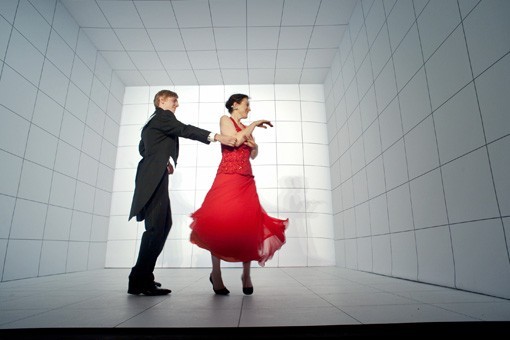
This is the actual set from a production of the play.
Secondly, we had to create a more basic, yet still interesting interpretation of the set. As we have less financing for this interpretation of the play, we had to create dynamic ideas that were interesting yet affordable. First of all, my original idea for the set (with the LED lights and geometric patterns) would overall, be far too expensive for a smaller budget. However, I still like the idea of the white, geometric set. Because of this, I believe that we could create a set similar to this original design, but just take away the more expensive elements- the LED bulbs and some of the storage space. To do this, we would need to physically paint the set in geometric patterns.

Because of the similarity between both sets, we could largely keep the lighting the same and we could still have dynamic colours and patterns projected onto the set to create the mood and feel of the scenes. Similarly, we could still have interesting costumes and colour schemes throughout the scenes that create a new feel and grit to each scene. The costume itself, however, could be kept far less lavish and expensive. To do this, instead of having separate pieces of clothing for each scene, we could have most of the actors wearing similar, plain clothes (perhaps in all white, or all black, depending on the scene). When it becomes their scene, they could add a particular new piece of clothing that represents their character (i.e.- a red scarf or a yellow pair of wellington boots). This would still create a stunning visual performance and would help to 'set the scene' in each change. Also, it would actually be beneficial in other ways- for example, it would help to reduce awkward, large costume changes. Without large pieces of clothing, costume changes would be simple and effective, and once they are done, the actor could safely stow their previous costume in the storage areas.

Another problem arises from the low budget- how will we store the props? I actually have many ideas about storing the props needed for each scene. Because of the lack of storage space in our chosen set design, we would need to think of an innovative way to store our props. It is quite difficult to think of a storage solution for our minimalistic set, however, I believe that I may have an answer- we could reuse props. Overall, I believe that the play itself can be interpreted in quite a Brechtian way (it's random scenes and sections could be used to alienate the audience and its fast paced layout could allow the audience to be enthralled with the play, yet still remember that it is a play). This interpretation can create a solution for the storage problem. In many of Bertolt Brecht's plays, he incorporates an interesting technique- reuse of simple props to represent a particular object. Rather than having many different props that have a specific use, we could have a few simple props that can be reused as different things. For example, we could have a suitcase that can portray a table, or a car or a chair- the possibilities are nearly endless. This would overall aid with the storage problem and would create an interesting interpretation of the play. We could even play with more Brechtian techniques (placards) and could write onto the prop what its function is (i.e. we could write 'car' onto the suitcase when it is acting as a car). Finally, this would help with the storage even more, as smaller props could be kept inside of the larger suitcase.

Finally, for both of the interpretations of the set, I believe that there should be a limited amount of actors and we should have around 16 actors present. Because of the nature of the play, simply having two or three actors would be insufficient as it would defeat the message of the play- it is set in real life, so must incorporate the multiculturalism and variety of real life. Also, too many characters would make the set rather crowded, as the actors have to stay on set throughout the performance.

Thursday, 22 September 2016

Animalistic (Chekhov)

During this lesson, we primarily thought of an animal that we felt represented our character from our monologues. Because of the anxious nature of my character, I felt that my character related to a meerkat.  My character is very nervous, yet protective and I felt that this related closely to how a meerkat acts.

Then we were told to focus on becoming 100% this animal. Because of this, I was running round the room with my hands clasped against my chest, stopping frequently to 'adjust my surroundings'. I had to take in the characteristics of the animal and portray them.

After a while of running round as a meerkat, we then had to 'tone down' the animal and rather than doing 100% animalistic characteristics, we needed to do 50% animal and 50%person. This was more challenging than the original as we had to focus on creating a mix between the animal and human. To do this, I began to walk lower on my feet (previously, I had been walking on 'tiptoes' to gain a meerkat look) and I held my hands in front of my chest but rather than holding them up like a meerkat, I clasped them and wrung them. This was the hardest stance to achieve because it wasn't a naturalistic position to be in. 

Finally, after 50%, we decided to move onto 100% human characteristics. However, we were to incorporate the animalistic gestures in a more human way. We took some of the characteristics into our character. For example, I continued to pace nervously and was uneasy on my feet. Also, I decided to include the clasping of my hands that had previously been the meerkats natural stance.

Furthermore, towards the end of the lesson, we had to create two other animals that were different from our original animal. I chose to become a lion and then an owl. Both of these animals are very different from my original meerkat. The lion is a lot more proud and
confident whereas the meerkat was afraid and startled. Also, the owl was angry yet wise which was largely different from my original animal. This helped me to think about opposing animals and opposing characteristics that I perhaps want to stay away from in the future.

Overall, I  believe that this technique was effective as it allowed me to create a more interesting performance visually and helped me to imagine my characters movements, and emotions more clearly.   

Gesture.

Whilst reviewing our monologues, we all decided that our group as a whole was lacking movements. All of our performances were static and lacked gesture. Because of this we decided to do a lesson on gesture and movement:

To begin with, we took one line from our monologue. I chose the line "Would you kindly move, asshole?!". Travelling around the room, we began to speak our chosen line aloud. Next, we changed the way we said this line. For example, we spoke in a whisper and then in an angry shout. This helped to explore the potential range of emotions in the particular line. Also, it helped as a warm up and prepared us for the next task.

Afterwards, we had to add a particular gesture to our line. It could be  a very simple movement like a twitch of the hands or feet, or more complex, like a shrug or a pace. Primarily, we combined the particular line with this chosen gesture. We continued to pace the room, this time focusing on both movement and voice. Next, we began to largely exaggerate our movements. A twitch of the feet became a skip and hand movements became arm and shoulder movements. Finally, we reviewed the process and decided on how exaggerated we should make our movements according to how it fit our character.

My movement became a large motion of my hands as I gestured in the air. Overall, I decided to use my movement at its most exaggerated. I decided this as I believed that it fully portrayed how emotional and angry my character felt.

Overall, I believe that this technique was successful as it made me think about each and every gesture I did in my monologue. Also, it allowed me to create a wider range of movements and helped me to focus on my gesture as well as my voice.


Rainbow of desire.

Throughout this lesson, we focused on Augusto Boal's technique- 'Rainbow of desire'.
'The Rainbow of desire' focuses on the idea of oppression within our emotions. During our lesson, however, we mostly just focused on the aspect of fear and oppression. The idea of the lesson was to study each others 'fear' and oppression. We were to see if we related to any of the emotions portrayed. Furthermore, this was overall, used to aid our own portrayal of such emotions.

To begin with, we laid on the ground and closed our eyes. Similarly to common yoga techniques, we began to almost drift into a sleep-like state. Once comfortable, we were told to focus on our 'happy place' and imagine how we feel and look in such a place. Personally, my 'happy place' was a comfortable bed with my best friend and family. Then, we were to imagine a colour and link it to how we felt and how it 'filled our bodies'. I imagined a gold colour radiating from my stomach and surrounding my entire body. It filled my veins and radiated warmth and happiness, this is how I picture my happiness and how I feel it looks and feel likes when I am in my happy place.  
However, it changed hugely when we were instructed to focus on an 'unhappy place'. We were told to remember when we felt oppressed and small. We were specifically told to focus on a time when another person was making us feel this way. This was a lot harder than the original task as it brought back memories that I wanted to forget.

Next we stood up again and remembered how  that unhappiness and fear felt. Then we formed a circle and everyone faced outwards. Almost to ourselves, we created a still image of this fear and steadily advanced the visuals of it- we added a repetitive movement. After the movement was added, we were instructed to add in a phrase which we repeated. This phrase was supposed to show how we felt inside, even if we didn't actually say our phrase when we were in the situation that we were remembering. I decided on the phrase "Go away". I added this to my still image and then decided that my movement should be added. My movement was clasping my hands and shuffling my feet. After we all created our movements and phrase, we turned inwards and focused on the others portrayal of fear.

After focusing on each others portrayals, we formed small groups with the people who we felt represented the same 'kind' of fear to us. Then we showed everyone our fears. We finally picked apart how we constructed the fear still image and compared how we portrayed fear. For example, my group were all clasping their hands around their chests and were uneasy on their feet.

Moreover, we 'flipped' the technique over and rather than portraying ourselves in fear, we portrayed our oppressors and how they felt. We did the same process yet focused on how the oppressors were feeling. We watched the others portrayal of their oppressors and surprisingly realised that there was a bit of relate-ability in the oppressors emotions. Although overall we felt opposed to the anger portrayed, many people realised that perhaps the oppressor was feeling different and weren't just our enemies- perhaps they felt hurt or lost. This showed us the true meaning of The Rainbow of desire; that there isn't just one overwhelming emotion and that even our oppressors feel emotion.

Finally, I believe that although this technique made me feel a bit uneasy and afraid, it was effective as it made me realise that fear is not so easy to replicate. Others have a different perception of fear and it is a very complex emotion to portray. Overall, I believe that this experience has aided me to develop my acting skills as a whole.

Tuesday, 20 September 2016

Why I chose this monologue:

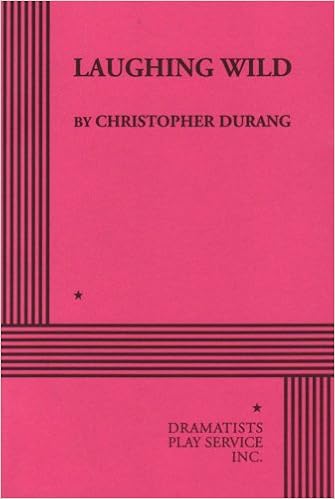
Over the summer, we were assigned a task to choose a monologue to perform in class. At first, I struggled to find an interesting monologue that I enjoyed performing. However, after hours of searching, I finally found a monologue which I enjoyed. Widely known as 'The tuna fish monologue', this monologue from Laughing Wild instantly appealed to me.

I mainly liked performing it as it differed from my usual choice of work. Usually, I perform more 'dramatic' and emotional pieces. The tuna fish monologue is vastly different-
although it has more serious underlying themes of mental illness, it portrays these themes in a more satirical and humorous way. Rather than looking at mental illness in an exaggerated dramatized way, it focuses on a more 'stripped back' portrayal of illnesses such as anxiety and depression. This is what largely intrigued me about the piece.

Furthermore, I believe that although I could produce a more simple portrayal of the character, I could uses these underlying themes to create an interesting performance of the monologue. Throughout the play, the mental state of the characters seems to deteriorate. Because of this, the beginning monologue is supposed to stay almost normal. At the start of the play, the audience is almost fooled into thinking that the characters are simply eccentric and unusual. However, I believed that although the monologue was supposed to show normality, there should be some 'symptoms' of her confused mental state.

Because of this, I believed that it would be beneficial to create some repeated movements. For example, I had an elastic band around my wrist that I plucked at when my character was agitated. This is a common technique used to 'reign' in unwanted emotions or desires. Throughout the monologue, I pulled at this band to show the audience that although the character appears vaguely normal, there is an underlying message of anxiety and illness.

I believe that this is effective as a whole. If the audience was to watch the whole play, they could remember the original monologue and realise that something was wrong, right from the beginning. Moreover, the repetitive movement makes the piece more interesting visually and intrigues the audience about the mental state of my character.


My monologue

Oh it’s all such a mess. Look at this mess. My hair is a mess. My clothes are a mess.

I want to talk to you about life. It’s just too difficult to be alive, isn’t it, and try to function? There are all these people to deal with. I tried to buy a can of tuna fish in the supermarket, and there was this person standing right in front of where I wanted to reach out to get the tuna fish, and I waited a while, to see if they’d move, and they didn’t—they were looking at tuna fish too, but they were taking a real long time on it, reading the ingredients on each can like they were a book, a pretty boring book if you ask me, but nobody has; so I waited a long while, and they didn’t move, and I couldn’t get to the tuna fish cans; and I thought about asking them to move, but then they seemed so stupid not to have sensed that I needed to get by them that I had this awful fear that it would do no good, no good at all, to ask them, they’d probably say something like, “We’ll move when we’re goddam ready you nagging bitch” and then what would I do?
And so then I started to cry out of frustration, quietly, so as not to disturb anyone, and still, even though I was softly sobbing, this stupid person didn’t grasp that I needed to get by them, and so I reached over with my fist, and I brought it down real hard on his head and screamed: “Would you kindly move asshole!!!”

And the person fell to the ground, and looked totally startled, and some child nearby started to cry, and I was still crying, and I couldn’t imagine making use of the tuna fish now anyway, and so I shouted at the child to stop crying—I mean, it was drawing too much attention to me—and I ran out of the supermarket, and I thought, I’ll take a taxi to the Metropolitan Museum of Art, I need to be surrounded with culture right now, not tuna fish.

Laughing Wild.

Written by Christopher Durang, Laughing Wild is a darkly comedic play which follows the story of two characters (simply called 'The Woman' and 'The Man'). Written and set in the late 1980's, Laughing Wild focuses on the struggles of living in an urban America. It has underlying theme of mental illness and is deeply relatable for any audience. It is uniquely written- it consists of two monologues and a play-let which brings the characters together.


Friday, 16 September 2016

Welcome to my Blog :)

Hello^-^
This is Emily Rogers' year twelve drama blog. I will be posting notes of all my lessons accordingly.