Friday, 30 December 2016

Grotowski and Pygmalion.

Throughout this lesson, we took the opening scene of the play- "Pygmalion", which involves a punning girl (Eliza), who gets her flowers knocked over by an onlooker. The pair then begin to argue. 

To connect this scene with Poor theatre, we decided that we would take the scene into an unusual space, that didn't nee any 'set-up'. To do this, we decided that we would take the scene outside onto the busy playground. This gave us an easy area to perform in, and it also gave us a large audience immediately. Moreover, it was an almost perfect site, as it was similar to the one in the play. 
We decided that we would portray the argument between the characters loosely. To do this, we had James (who represented Freddy knocking over Eliza's flowers), who slammed into the year sevens and threw their crisps around. Then Sophie (who represented Higgins), began shouting at the kids and threw the remains of the crisps in their faces. She got progressively angry and began screaming at the year sevens. The rest of our class either tried to calm her down, or stayed back (we represented the onlookers). Finally, when the teachers were alerted, we stopped and told the audience that we were just performing a piece. 

Overall, this was very successful as the onlookers soon became enthralled in the action and many people even ran to get a teacher. It was effective as it showed us how fluid and unique any piece of poor theatre can be. Just because there is no complex set or stage, doesn't mean that the performance is any less interesting and complex. Moreover, it shows us how we can use the themes of the play we choose to create an interesting piece. 

Grotowski.

Jerzy Grotowski and poor theatre:
Nowadays, Jerzy Grotowski is well-known as one of the greatest directors in more modern theatre. He is most well-known for one particular type of theatre. This is called 'Poor theatre':

Poor theatre is usually performed in any bare space available. For example, it can be performed in a huge number of places- a hall, or a classroom or even outside in a large open space. Because of this, his techniques are rather attractive to students and school departments as it isn't necessary for a huge budget to be spent. 

Typically, Grotowski preferred create performances and works in non-traditional spaces, such as abandoned rooms and buildings, rather than the more usual stage and playhouse environment. Moreover, he also used unusual staging types, and commonly placed the audience around the action or even within it.

Theory:
  • Notable influences on Grotowski's work included Brecht and Stanislavski.
  • Usually, a large amount of Grotowski's work focused on actor training.
  • He was arguably known as the having the most intensive actor training after Stanislavski.
  • All of theatre's excess is stripped away in poor theatre, and only the necessary is kept.
  • Grotowski believed that theatre is never able to compete with film and television, so it should not attempt to.
  • Few of the Poor theatre works actually made performance.
  • Those that did were usually shown to only a small group of spectators, and were only ever shown once. 
  • Grotowski ended all public performances in 1975. 

Friday, 2 December 2016

George Tesman

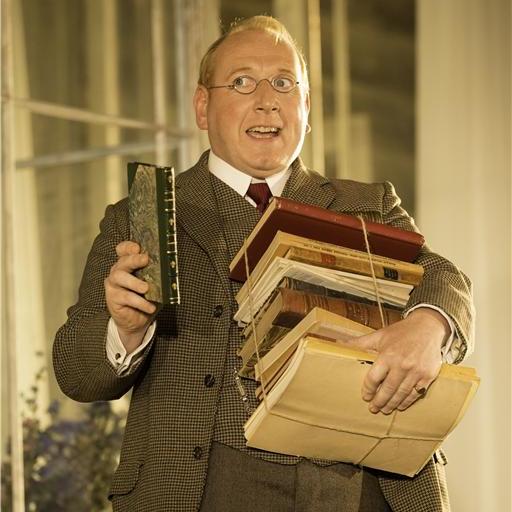
If i was to cast an actor for the role of Tesman, I would cast "Adrian Scarborough".
I envisage Tesman as middle aged, a little weary and quite bumbly. He is happy, yet oblivious, and Hedda means everything to him. 
Cotume:
I would actually use a costume that is imilar to the picture. When he is going out or wearing daily clothes, he would be wearing a suit. It would be a bit battererd and obviously worn out as this would show how little money he has in comparison to Hedda. It would be in a brown or mustard colour as he simply cannot afford anything nicer. his trousers would be of the same colour, but perhaps a different shade, which further shows us his obliviousness and status. 
When he was wearing nightclothes, i imagine him wearing a long dressing gown. This would be stained and worn yet again, as this is what he usually wears. 
Sound:
I think that is you were putting on a more 'pantomine' version of the play, you could have a plodding, rythmic tune that marks his footsteps. However, if it was more serious, you could just have a more jolly tune that marks his entry. 
Lighting:
Finally, I believe that his lighting would be rather like himself- it would be rather patchy in places yet still bright.