Thursday, 29 September 2016

Monologue editing.

Throughout this lesson we focused on editing our monologues. To begin with, we took a copy of our own monologues and deleted any words which weren't verbs or adjectives. This is what mine was reduced to:

'deal  tried buy  standing  front reach a while,  move, looking taking real long , reading   a pretty boring ask  waited long move,  thought asking move, stupid sensed  needed awful fear ask say move goddam nagging 
 to cry, quietly,softly sobbing, stupid grasp reached brought real hard screamed: kindly move asshole!!!”
fell totally startled, cry, shouted crying drawing attention.'

Primarily, this was quite a difficult thing to do as there was a lot of text to go through, but I got the hang of it in the end. I then performed my monologue in it's reduced version. Although a huge part of the text was gone, it still kind of made sense to those watching. This beginning exercise was effective as it showed me that 30/70% of a text can be whatever we make of it- it can be reduced hugely and still remain understandable. This links into my drama reinterpretation as we need to take 30/70% of a text to devise our performances form.
Furthermore, as well as linking to my later performances it helped me to see that everything matters in my monologue and it also helped me to understand my characters honest, thoughts and objectives. Stripping it back to its simplest was effective as it helped me to see my characters objectives in each line, which helps me to understand what my character truly wants.

Finally, towards the end of the lesson, we decided to do a different exercise with other people's monologues. I took Fiona's monologue, which was from 'After Juliet', and was told to reinterpret the meaning. I edited particular words and sentences in her monologue to change the meaning. This also linked into our reinterpretations as I kept some of the original text and edited or removed the rest.
This monologue is about Rosaline (who was in love with Romeo in Shakespeare's classic- 'Romeo and Juliet'), she speaks about how betrayed she feels after the death of Romeo. The monologue takes a more aggressive tone as she is angry towards her cousin, Juliet, for killing her love.
However, my task was to change the meaning of the monologue, so rather than being angry, I made the tone sad and obsessive. Rather than showing hatred towards Juliet, I made her seem almost in love with Juliet. I changed many lines to almost say the opposite of what she means and overall made her appear in grief from Juliet's passing and not Romeo's.
Overall, this exercise was effective as it showed me how little or how much I can include in my reinterpretation. Even if I keep a large amount of the original lines, I can still change the tone and meaning hugely.

Sunday, 25 September 2016

Vocal lesson.

As we had previously focused on our movements, we decided to focus on our vocals for this lesson. We decided to continue focusing on our character from our monologues. Although we all had learnt our monologues fully, a lot of us realised that we didn't truly understand our characters- we didn't have a clear 'voice' for them inside our heads. Because of this, we decided to focus on our characters and tried to create a deeper understanding of how they speak and think.

To do this, we split off into groups of 3 and one by one, told the others who our characters were and how we originally felt the spoke. Originally, I believed that my character was well-spoken and was brought up well. I thought this because; although h my character has mental-health issues, she never addresses them and they are almost not spoken of. Throughout the play, we see her decline into a deeper state of illness, however, she never addresses her illness and doesn't seek out a doctor or help for her state. Moreover, I believe that she is was taught as a child to be well-spoken. I think this because she seems to use curse words as a 'last resort' . Se only uses them when absolutely necessary, and her 'worst' swear word is- 'bitch'. Also, even when she is extremely distressed, she still remains polite and well-spoken. Because of these factors, I believe that me character is rather 'posh' and had a traditional upbringing.

I told my group this and we all agreed on her upbringing. However, my group had the idea that I could perhaps play with the idea of my character having an accent. The accent in particular would be upper class, Australian. Although I struggle doing accents, I tried to vocalise this specific accent. To do this, I listened to recordings of the Australian accent and focused on how different it was from mine. Whilst doing this, I realised that there are many slight differences between the accents themselves. For example, Australians appear to speak at a much faster pace and also 'drop' vowels and letters to increase the speed of their conversations.

I took all of this into consideration and attempted an Australian accent with my character. Although I like the effect it had on my character (it made her seem more nervous and made my monologue more interesting), I am not very good at the accent itself and believe that it wasn't very believable. However,  I will continue to try and develop this accent. For now, my character remains a well-spoken, upper classed Brit.

Overall, I believe that this technique was effective as it made me think about my character and her voice in more detail. I fell like I know and understand my character more now.

Love and information.

We decided in this lesson to begin to read one of our exam plays- Love and Information. We read the first Act and delegated characters to people in our class. This in itself was harder than first imagined, as the play doesn't actually have scripted characters or lines. Because of this, we decided to alternate lines between two people every scene. I thought that this was effective as most of  the scenes are quite short and only really need two characters. Later on, we may decide to incorporate a larger cast in the scenes but I believe that, for now, this idea was effective.

Whilst reading the first few scenes, we realised that Love and Information is written in a very unique way: there are no characters scripted and the lines are set out like a large monologue. Also, there was little punctuation and most of the lines relied on enjambment and continued onto the next line. Moreover, there were little stage directions or set present in the text. Although unusual, I like the way Love and Information is written as it is widely open to interpretation. For example, there could be as many actors as we needed as there are no particular scripted lines- we could have as little as three actors or as many as 100. Furthermore, another aspect of the play that is open to interpretation is the set design.

Throughout this lesson, we focused mainly on this aspect of the play and decided to imagine what set we would use if we were doing a production of the play. First of all, we had to review a few practical considerations:
  • There are 57 scene changes but the characters don't enter or exit during the scenes.
  • There is a maximum of 100 characters.
  • The play is divided into 7 sections.
  • The running time of individual scenes range from 5 seconds to 5 minutes.
  • The total running of the play is under 2 hours.
  • There is a limited storage space backstage.
  • The stage is proscenium arch.
Obviously, these points will largely impact any set design. Because of this, we needed to create a few design ideas for tackling the issues that arise from these needs. We decided to create two different set design ideas, one with an almost infinite finance and one that has less money to spend.

Our original design (with more financing):
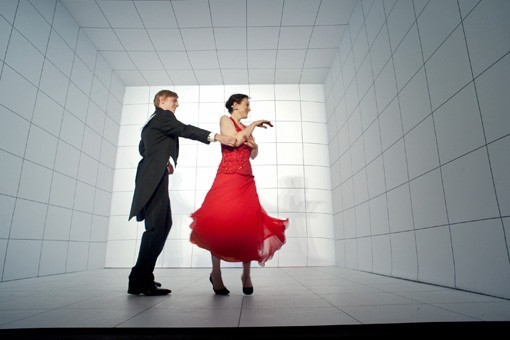
Primarily, I decided to create a more lavish idea. For the actual set and staging, I was largely inspired by The curious incident of the dog in the night-time. When I went to see this play, I was hugely inspired by the set design- the geometric patterns created a large open space that the actors could make their own. The openness and simplicity of the set allowed the actors to bring a beautiful, unique look into each scene. Furthermore, not only did the set act as a beautiful focal point, it also cleverly acted as storage space for all of the props and costume. Most of the separate squares would actually be a drawer and the actors got most of their props from inside the set. This flawlessly created a beautiful set that cleverly acted as storage space.

Moreover, the set itself was actually made up of thousands of LED bulbs. Images were projected onto the set and most of the lighting came from the walls themselves or the lights from above. Ideally, we could use this technique throughout the production of Love and Information. However, as The curious incident was set inside of the main characters head, it has a dark and geometric feel. Although this was incredibly effective, I believe that Love and Information has a much more fluid and changeable look. Because of this, I would almost invert the colours of the set and have a white background with white geometric patterns. I believe this would be more effective in this instance as it would allow for more open interpretations of the scenes. Furthermore, we could use this as a 'blank canvas' and we could play with the use of colour in the scenes. For example, we could have important characters wearing deep reds or blues and we could even play with the lighting- the lighting could create different feels between scenes and could help to introduce our scenes and characters. Moreover, the play incorporates several random scenes labelled 'Depression', due to the severity and darkness of these scenes, we could use the simplicity of the set to our advantage- we could turn the lights down and have a momentarily piece of darkness to portray the depression.  

Finally, my final idea for this set was about the props. We could keep the main props inside of the handy storage space in the set (i.e.- chairs and costume). However, we could keep the smaller, more important pieces of prop (i.e.- a red rose, a book, etc.) hanging from the ceiling on thin lines of fishing wire. They could dangle just in the view of the audience and when needed, the wire could be cut and the prop would fall. In the most ideal world, we could carefully coordinate and direct the actors to catch their corresponding prop for each scene. This would be difficult to coordinate but would pay off in the long run- it would produce a flawless, unique interpretation of the play. It would combine stunning visuals with practical storage space and would overall create a beautiful production of the play.

My second design (with less financing):
This is the actual set from a production of the play.
Secondly, we had to create a more basic, yet still interesting interpretation of the set. As we have less financing for this interpretation of the play, we had to create dynamic ideas that were interesting yet affordable. First of all, my original idea for the set (with the LED lights and geometric patterns) would overall, be far too expensive for a smaller budget. However, I still like the idea of the white, geometric set. Because of this, I believe that we could create a set similar to this original design, but just take away the more expensive elements- the LED bulbs and some of the storage space. To do this, we would need to physically paint the set in geometric patterns.

Because of the similarity between both sets, we could largely keep the lighting the same and we could still have dynamic colours and patterns projected onto the set to create the mood and feel of the scenes. Similarly, we could still have interesting costumes and colour schemes throughout the scenes that create a new feel and grit to each scene. The costume itself, however, could be kept far less lavish and expensive. To do this, instead of having separate pieces of clothing for each scene, we could have most of the actors wearing similar, plain clothes (perhaps in all white, or all black, depending on the scene). When it becomes their scene, they could add a particular new piece of clothing that represents their character (i.e.- a red scarf or a yellow pair of wellington boots). This would still create a stunning visual performance and would help to 'set the scene' in each change. Also, it would actually be beneficial in other ways- for example, it would help to reduce awkward, large costume changes. Without large pieces of clothing, costume changes would be simple and effective, and once they are done, the actor could safely stow their previous costume in the storage areas.

Another problem arises from the low budget- how will we store the props? I actually have many ideas about storing the props needed for each scene. Because of the lack of storage space in our chosen set design, we would need to think of an innovative way to store our props. It is quite difficult to think of a storage solution for our minimalistic set, however, I believe that I may have an answer- we could reuse props. Overall, I believe that the play itself can be interpreted in quite a Brechtian way (it's random scenes and sections could be used to alienate the audience and its fast paced layout could allow the audience to be enthralled with the play, yet still remember that it is a play). This interpretation can create a solution for the storage problem. In many of Bertolt Brecht's plays, he incorporates an interesting technique- reuse of simple props to represent a particular object. Rather than having many different props that have a specific use, we could have a few simple props that can be reused as different things. For example, we could have a suitcase that can portray a table, or a car or a chair- the possibilities are nearly endless. This would overall aid with the storage problem and would create an interesting interpretation of the play. We could even play with more Brechtian techniques (placards) and could write onto the prop what its function is (i.e. we could write 'car' onto the suitcase when it is acting as a car). Finally, this would help with the storage even more, as smaller props could be kept inside of the larger suitcase.

Finally, for both of the interpretations of the set, I believe that there should be a limited amount of actors and we should have around 16 actors present. Because of the nature of the play, simply having two or three actors would be insufficient as it would defeat the message of the play- it is set in real life, so must incorporate the multiculturalism and variety of real life. Also, too many characters would make the set rather crowded, as the actors have to stay on set throughout the performance.

Thursday, 22 September 2016

Animalistic (Chekhov)

During this lesson, we primarily thought of an animal that we felt represented our character from our monologues. Because of the anxious nature of my character, I felt that my character related to a meerkat.  My character is very nervous, yet protective and I felt that this related closely to how a meerkat acts.

Then we were told to focus on becoming 100% this animal. Because of this, I was running round the room with my hands clasped against my chest, stopping frequently to 'adjust my surroundings'. I had to take in the characteristics of the animal and portray them.

After a while of running round as a meerkat, we then had to 'tone down' the animal and rather than doing 100% animalistic characteristics, we needed to do 50% animal and 50%person. This was more challenging than the original as we had to focus on creating a mix between the animal and human. To do this, I began to walk lower on my feet (previously, I had been walking on 'tiptoes' to gain a meerkat look) and I held my hands in front of my chest but rather than holding them up like a meerkat, I clasped them and wrung them. This was the hardest stance to achieve because it wasn't a naturalistic position to be in. 

Finally, after 50%, we decided to move onto 100% human characteristics. However, we were to incorporate the animalistic gestures in a more human way. We took some of the characteristics into our character. For example, I continued to pace nervously and was uneasy on my feet. Also, I decided to include the clasping of my hands that had previously been the meerkats natural stance.

Furthermore, towards the end of the lesson, we had to create two other animals that were different from our original animal. I chose to become a lion and then an owl. Both of these animals are very different from my original meerkat. The lion is a lot more proud and
confident whereas the meerkat was afraid and startled. Also, the owl was angry yet wise which was largely different from my original animal. This helped me to think about opposing animals and opposing characteristics that I perhaps want to stay away from in the future.

Overall, I  believe that this technique was effective as it allowed me to create a more interesting performance visually and helped me to imagine my characters movements, and emotions more clearly.   

Gesture.

Whilst reviewing our monologues, we all decided that our group as a whole was lacking movements. All of our performances were static and lacked gesture. Because of this we decided to do a lesson on gesture and movement:

To begin with, we took one line from our monologue. I chose the line "Would you kindly move, asshole?!". Travelling around the room, we began to speak our chosen line aloud. Next, we changed the way we said this line. For example, we spoke in a whisper and then in an angry shout. This helped to explore the potential range of emotions in the particular line. Also, it helped as a warm up and prepared us for the next task.

Afterwards, we had to add a particular gesture to our line. It could be  a very simple movement like a twitch of the hands or feet, or more complex, like a shrug or a pace. Primarily, we combined the particular line with this chosen gesture. We continued to pace the room, this time focusing on both movement and voice. Next, we began to largely exaggerate our movements. A twitch of the feet became a skip and hand movements became arm and shoulder movements. Finally, we reviewed the process and decided on how exaggerated we should make our movements according to how it fit our character.

My movement became a large motion of my hands as I gestured in the air. Overall, I decided to use my movement at its most exaggerated. I decided this as I believed that it fully portrayed how emotional and angry my character felt.

Overall, I believe that this technique was successful as it made me think about each and every gesture I did in my monologue. Also, it allowed me to create a wider range of movements and helped me to focus on my gesture as well as my voice.


Rainbow of desire.

Throughout this lesson, we focused on Augusto Boal's technique- 'Rainbow of desire'.
'The Rainbow of desire' focuses on the idea of oppression within our emotions. During our lesson, however, we mostly just focused on the aspect of fear and oppression. The idea of the lesson was to study each others 'fear' and oppression. We were to see if we related to any of the emotions portrayed. Furthermore, this was overall, used to aid our own portrayal of such emotions.

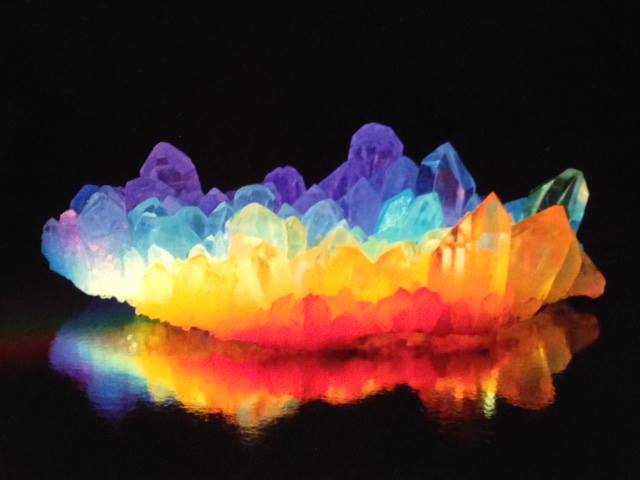
To begin with, we laid on the ground and closed our eyes. Similarly to common yoga techniques, we began to almost drift into a sleep-like state. Once comfortable, we were told to focus on our 'happy place' and imagine how we feel and look in such a place. Personally, my 'happy place' was a comfortable bed with my best friend and family. Then, we were to imagine a colour and link it to how we felt and how it 'filled our bodies'. I imagined a gold colour radiating from my stomach and surrounding my entire body. It filled my veins and radiated warmth and happiness, this is how I picture my happiness and how I feel it looks and feel likes when I am in my happy place.  
However, it changed hugely when we were instructed to focus on an 'unhappy place'. We were told to remember when we felt oppressed and small. We were specifically told to focus on a time when another person was making us feel this way. This was a lot harder than the original task as it brought back memories that I wanted to forget.

Next we stood up again and remembered how  that unhappiness and fear felt. Then we formed a circle and everyone faced outwards. Almost to ourselves, we created a still image of this fear and steadily advanced the visuals of it- we added a repetitive movement. After the movement was added, we were instructed to add in a phrase which we repeated. This phrase was supposed to show how we felt inside, even if we didn't actually say our phrase when we were in the situation that we were remembering. I decided on the phrase "Go away". I added this to my still image and then decided that my movement should be added. My movement was clasping my hands and shuffling my feet. After we all created our movements and phrase, we turned inwards and focused on the others portrayal of fear.

After focusing on each others portrayals, we formed small groups with the people who we felt represented the same 'kind' of fear to us. Then we showed everyone our fears. We finally picked apart how we constructed the fear still image and compared how we portrayed fear. For example, my group were all clasping their hands around their chests and were uneasy on their feet.

Moreover, we 'flipped' the technique over and rather than portraying ourselves in fear, we portrayed our oppressors and how they felt. We did the same process yet focused on how the oppressors were feeling. We watched the others portrayal of their oppressors and surprisingly realised that there was a bit of relate-ability in the oppressors emotions. Although overall we felt opposed to the anger portrayed, many people realised that perhaps the oppressor was feeling different and weren't just our enemies- perhaps they felt hurt or lost. This showed us the true meaning of The Rainbow of desire; that there isn't just one overwhelming emotion and that even our oppressors feel emotion.

Finally, I believe that although this technique made me feel a bit uneasy and afraid, it was effective as it made me realise that fear is not so easy to replicate. Others have a different perception of fear and it is a very complex emotion to portray. Overall, I believe that this experience has aided me to develop my acting skills as a whole.

Tuesday, 20 September 2016

Why I chose this monologue:

Over the summer, we were assigned a task to choose a monologue to perform in class. At first, I struggled to find an interesting monologue that I enjoyed performing. However, after hours of searching, I finally found a monologue which I enjoyed. Widely known as 'The tuna fish monologue', this monologue from Laughing Wild instantly appealed to me.

I mainly liked performing it as it differed from my usual choice of work. Usually, I perform more 'dramatic' and emotional pieces. The tuna fish monologue is vastly different-
although it has more serious underlying themes of mental illness, it portrays these themes in a more satirical and humorous way. Rather than looking at mental illness in an exaggerated dramatized way, it focuses on a more 'stripped back' portrayal of illnesses such as anxiety and depression. This is what largely intrigued me about the piece.

Furthermore, I believe that although I could produce a more simple portrayal of the character, I could uses these underlying themes to create an interesting performance of the monologue. Throughout the play, the mental state of the characters seems to deteriorate. Because of this, the beginning monologue is supposed to stay almost normal. At the start of the play, the audience is almost fooled into thinking that the characters are simply eccentric and unusual. However, I believed that although the monologue was supposed to show normality, there should be some 'symptoms' of her confused mental state.

Because of this, I believed that it would be beneficial to create some repeated movements. For example, I had an elastic band around my wrist that I plucked at when my character was agitated. This is a common technique used to 'reign' in unwanted emotions or desires. Throughout the monologue, I pulled at this band to show the audience that although the character appears vaguely normal, there is an underlying message of anxiety and illness.

I believe that this is effective as a whole. If the audience was to watch the whole play, they could remember the original monologue and realise that something was wrong, right from the beginning. Moreover, the repetitive movement makes the piece more interesting visually and intrigues the audience about the mental state of my character.


My monologue

Oh it’s all such a mess. Look at this mess. My hair is a mess. My clothes are a mess.

I want to talk to you about life. It’s just too difficult to be alive, isn’t it, and try to function? There are all these people to deal with. I tried to buy a can of tuna fish in the supermarket, and there was this person standing right in front of where I wanted to reach out to get the tuna fish, and I waited a while, to see if they’d move, and they didn’t—they were looking at tuna fish too, but they were taking a real long time on it, reading the ingredients on each can like they were a book, a pretty boring book if you ask me, but nobody has; so I waited a long while, and they didn’t move, and I couldn’t get to the tuna fish cans; and I thought about asking them to move, but then they seemed so stupid not to have sensed that I needed to get by them that I had this awful fear that it would do no good, no good at all, to ask them, they’d probably say something like, “We’ll move when we’re goddam ready you nagging bitch” and then what would I do?
And so then I started to cry out of frustration, quietly, so as not to disturb anyone, and still, even though I was softly sobbing, this stupid person didn’t grasp that I needed to get by them, and so I reached over with my fist, and I brought it down real hard on his head and screamed: “Would you kindly move asshole!!!”

And the person fell to the ground, and looked totally startled, and some child nearby started to cry, and I was still crying, and I couldn’t imagine making use of the tuna fish now anyway, and so I shouted at the child to stop crying—I mean, it was drawing too much attention to me—and I ran out of the supermarket, and I thought, I’ll take a taxi to the Metropolitan Museum of Art, I need to be surrounded with culture right now, not tuna fish.

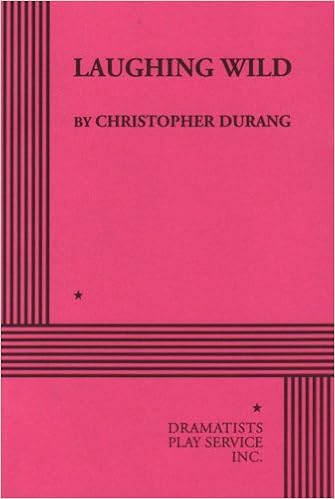
Laughing Wild.

Written by Christopher Durang, Laughing Wild is a darkly comedic play which follows the story of two characters (simply called 'The Woman' and 'The Man'). Written and set in the late 1980's, Laughing Wild focuses on the struggles of living in an urban America. It has underlying theme of mental illness and is deeply relatable for any audience. It is uniquely written- it consists of two monologues and a play-let which brings the characters together.


Friday, 16 September 2016

Welcome to my Blog :)

Hello^-^
This is Emily Rogers' year twelve drama blog. I will be posting notes of all my lessons accordingly.