Whilst reading the first few scenes, we realised that Love and Information is written in a very unique way: there are no characters scripted and the lines are set out like a large monologue. Also, there was little punctuation and most of the lines relied on enjambment and continued onto the next line. Moreover, there were little stage directions or set present in the text. Although unusual, I like the way Love and Information is written as it is widely open to interpretation. For example, there could be as many actors as we needed as there are no particular scripted lines- we could have as little as three actors or as many as 100. Furthermore, another aspect of the play that is open to interpretation is the set design.
Throughout this lesson, we focused mainly on this aspect of the play and decided to imagine what set we would use if we were doing a production of the play. First of all, we had to review a few practical considerations:
- There are 57 scene changes but the characters don't enter or exit during the scenes.
- There is a maximum of 100 characters.
- The play is divided into 7 sections.
- The running time of individual scenes range from 5 seconds to 5 minutes.
- The total running of the play is under 2 hours.
- There is a limited storage space backstage.
- The stage is proscenium arch.
Our original design (with more financing):

Moreover, the set itself was actually made up of thousands of LED bulbs. Images were projected onto the set and most of the lighting came from the walls themselves or the lights from above. Ideally, we could use this technique throughout the production of Love and Information. However, as The curious incident was set inside of the main characters head, it has a dark and geometric feel. Although this was incredibly effective, I believe that Love and Information has a much more fluid and changeable look. Because of this, I would almost invert the colours of the set and have a white background with white geometric patterns. I believe this would be more effective in this instance as it would allow for more open interpretations of the scenes. Furthermore, we could use this as a 'blank canvas' and we could play with the use of colour in the scenes. For example, we could have important characters wearing deep reds or blues and we could even play with the lighting- the lighting could create different feels between scenes and could help to introduce our scenes and characters. Moreover, the play incorporates several random scenes labelled 'Depression', due to the severity and darkness of these scenes, we could use the simplicity of the set to our advantage- we could turn the lights down and have a momentarily piece of darkness to portray the depression.
Finally, my final idea for this set was about the props. We could keep the main props inside of the handy storage space in the set (i.e.- chairs and costume). However, we could keep the smaller, more important pieces of prop (i.e.- a red rose, a book, etc.) hanging from the ceiling on thin lines of fishing wire. They could dangle just in the view of the audience and when needed, the wire could be cut and the prop would fall. In the most ideal world, we could carefully coordinate and direct the actors to catch their corresponding prop for each scene. This would be difficult to coordinate but would pay off in the long run- it would produce a flawless, unique interpretation of the play. It would combine stunning visuals with practical storage space and would overall create a beautiful production of the play.
My second design (with less financing):
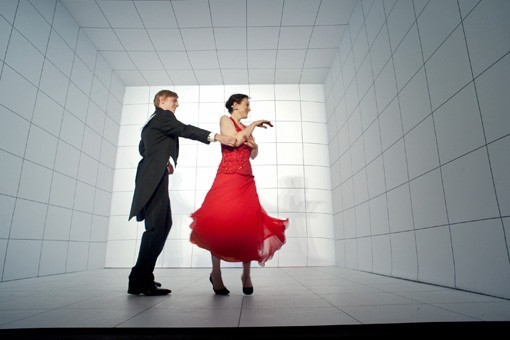 |
| This is the actual set from a production of the play. |
Because of the similarity between both sets, we could largely keep the lighting the same and we could still have dynamic colours and patterns projected onto the set to create the mood and feel of the scenes. Similarly, we could still have interesting costumes and colour schemes throughout the scenes that create a new feel and grit to each scene. The costume itself, however, could be kept far less lavish and expensive. To do this, instead of having separate pieces of clothing for each scene, we could have most of the actors wearing similar, plain clothes (perhaps in all white, or all black, depending on the scene). When it becomes their scene, they could add a particular new piece of clothing that represents their character (i.e.- a red scarf or a yellow pair of wellington boots). This would still create a stunning visual performance and would help to 'set the scene' in each change. Also, it would actually be beneficial in other ways- for example, it would help to reduce awkward, large costume changes. Without large pieces of clothing, costume changes would be simple and effective, and once they are done, the actor could safely stow their previous costume in the storage areas.
Another problem arises from the low budget- how will we store the props? I actually have many ideas about storing the props needed for each scene. Because of the lack of storage space in our chosen set design, we would need to think of an innovative way to store our props. It is quite difficult to think of a storage solution for our minimalistic set, however, I believe that I may have an answer- we could reuse props. Overall, I believe that the play itself can be interpreted in quite a Brechtian way (it's random scenes and sections could be used to alienate the audience and its fast paced layout could allow the audience to be enthralled with the play, yet still remember that it is a play). This interpretation can create a solution for the storage problem. In many of Bertolt Brecht's plays, he incorporates an interesting technique- reuse of simple props to represent a particular object. Rather than having many different props that have a specific use, we could have a few simple props that can be reused as different things. For example, we could have a suitcase that can portray a table, or a car or a chair- the possibilities are nearly endless. This would overall aid with the storage problem and would create an interesting interpretation of the play. We could even play with more Brechtian techniques (placards) and could write onto the prop what its function is (i.e. we could write 'car' onto the suitcase when it is acting as a car). Finally, this would help with the storage even more, as smaller props could be kept inside of the larger suitcase.
Finally, for both of the interpretations of the set, I believe that there should be a limited amount of actors and we should have around 16 actors present. Because of the nature of the play, simply having two or three actors would be insufficient as it would defeat the message of the play- it is set in real life, so must incorporate the multiculturalism and variety of real life. Also, too many characters would make the set rather crowded, as the actors have to stay on set throughout the performance.

No comments:
Post a Comment