Monday, 28 November 2016

Pygmalion and Forum theatre.

At the beginning of this lesson, we looked at this scene in Pygmalion. This scene is the opening section of the play and consist of a few characters trying to get away from the rain. The main character, the flower girl (Eliza), gets her flowers knocked over and because of this, argues with another character. She becomes increasingly aggravated with this gentleman and also argues with another man, who turns out to be friends with the first gentleman. In the end, she receives lots of money from the man and leaves in a taxi, however, she is still poor and her flowers are ruined.

We ran through this scene normally at first, then we took the scene and used forum theatre to explore how the outcome can change.
Firstly, James decided to see how the scene would change if Eliza never had her flowers knocked over by the man. This was actually not beneficial for Eliza as she gained a lot of money out of pity and not through selling her flowers. Therefore, if her flowers were not knocked over, she would not receive and more money, and her life will not change.

Then, we decided to work the scene if the bystanders and gentlemen were kinder to Eliza. We saw that the gentleman would offer Eliza a place to sleep straight away. However, Eliza was very wary about this prospect and decided not to go with the man. Therefore, nothing changed for her.

Overall, out of all of the changes we completed, the original scene actually appears to be the most beneficial to Eliza. However, it would have been interesting to observe how these slight changes would effect the entire play, and how this would effect Eliza and her life later on in the play.

Forum Theatre.

We decided to look at a new theatre type this lesson. This is a unique type of theatre that is developed by Brazilian practitioner Augusto Boal. Usually, the genre of his plays was some kind of oppression and Boal also used his technique- 'The rainbow of desire' heavily.
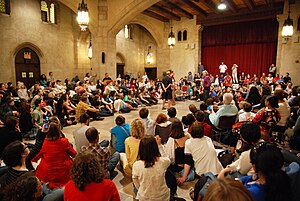
Boal decided to create a new kind of theatre in which the audience can participate within the action of the show.


To do this, a play or scene would be shown two times to the audience and during the second version, the audience was encouraged to shout 'Stop' and take the place of one of the characters in the scene. This is used to observe how the situation can change and enable a different outcome in the end. These participants are called spect-actors and many different outcomes can be explored in one show.
The other actors remain in their role and improvise their responses. In order to smoothly enable communication between the actors and the audience, a facilitator (Joker) is needed.

This technique breaks the fourth wall between the performers and the actors which puts them on equal levels. It allows the audience to try out courses of action which are applicable to their daily lives. Originally, Boal developed the technique as a tool for political change, but it had been adapted and is widely used in educational contexts.

Love and information- 'Grief'.

In this lesson, we each got into small groups. We were then told to choose one of the scenes out of a Love and Information. I teamed up with Fiona and we took the scene 'Grief':
I read the red lines, and Fio read the black ones:

Are you sleeping?
I wake up early, but that's all right in the summer.
Eating?
Oh enough. Don't fuss.
I've never had someone die.
I'm sorry, I've nothing to say.
Nothing seems very interesting.
He must have meant everything to you.
Maybe. We'll see.

After reading the scene through, we needed to think of three different ideas how we could perform the piece. These are our ideas:

1- We created a really detailed couple who appeared to be form a soap opera. The couple are actually divorces, and the wife has begun a new relationship with another man. This made the husband incredibly jealous, so he murdered the wives new boyfriend. She doesn't know of this, and when the husband attempts to console her over his death, she is confused yet happy. He is trying to make her fall back in love with him.
We decided to try and portray this by being very melodramatic and over the top. However, this was very hard to portray as we only had a short scene, so showing all this information was rather difficult.

2- Next, we decided to look into the scene in a slightly different way. To do this, we decided that the characters were young children (around 7 or 8). They were discussing the death of an imaginary friend. They are in a playground on the swing set. This was easier to portray as we just had to physicalize and vocalise a child, which would show the story.

3- Our final idea was that the person in red was a psychiatrist and the other person was somebody mourning their brother. The mourner was 18, and the psychiatrist was around 60. This was easy to interpret, as we simply created a physiatrist office with the staging, and then had one person lying in the chair and the other standing and speaking to them. This was okay to perform as it became obvious where they were. However, the psychiatrists lines became rather vague. They say "I'm sorry, I've nothing to say", and this is very unprofessional for a psychiatrist. This is why we decided that perhaps the psychiatrist was older. He was tired and close to retirement, which is why he wasn't doing very well in his job.

Berkoff and the Glass menagerie.

During this lesson, we decided to take our previously studied practitioner and one of our possible texts. We took a particular scene from the play 'The Glass Menagerie' and attempted to make it Berkoffian in style. To do this, we broke off into pairs and edited our scenes. Me and Sam decided to do a scene where Amanda and Tom are eating dinner. The scene starts off with Amanda shouting at Tom for 'pushing' at his food with his fingers, and then descends into Tom retaliating and answering back towards Amanda. 

To make this more Berkoff in style, we choreographed the eating at the beginning of the scene, and used the technique of robotic movements- they ate as if they were robots. This was particularly effective as it was visually interesting, yet also portrayed how the pair had become like clockwork. 

Then Sam and I turned in sync towards the audience and performed certain lines towards them, in chorus. This is a mixture of Berkoff's techniques and was rather effective. Finally, we stood in sync and did a small choreographed section of movement. We made this unique as Sam was facing the audience, but I had my back to them, and turned away. I believe that this was effective as it showed how strained our relationship was. 

Berkoff.

During this lesson, we decided to continue looking at Berkoff as a practitioner. We took this short section form hie play Metamorphosis:
"I liked hanging from the ceiling. It was better than the floor- one breaths more freely- and i can swing and rock backwards and forwards, forwards and backwards- i feel so light, and i can see the hospital across the street- all i can see from the floor is a drab, grey sky- i so much wanted to see my mother- it's so long since i have seen her- perhaps i am too hideous ever to see her again."

During this scene, the main character has been turned into a bug, presumably a cockroach. To portray this, we had three people at the top of a stack of set blocks and three entwined underneath them. The people who were sat on the staging were grotesquely placed, and all sat in similar positions. The people below were balancing inside the set, also in a similar position. During the performance, the people wt the top of the set had high pitched voices, and those at the bottom had lower pitched voices. This is a Berkoffian technique as he focuses on using varied pitch to portray character. We also had small sections of physicalisation throughout the piece, for example, for the line 'I feel so light', the three at the bottom of the staging got out and did a light to portray the feeling of lightness. 

Overall, this incorporated with the range of pitches made the performance very effective as it was full of Berkoffian techniques. 

Love and information short film.

During this lesson, we watched a short film interpretation of the script- 'Love and Information'. The film was quite good, but it only included these scenes:

  • Sleep
  • Secret
  • Affair
  • Fired
  • Terminal
  • God's voice
  • God
  • Maths
  • Flashback
  • Rash
  • Shrink
  • Cold
  • Decision
  • Keys
  • Wife
  • Virtual
Were there any scenes that were particularly effective?
Overall, I think the most effective scene was 'Wife'. The scene is based around a couple, and the wife appears to be convincing the husband that she is still herself. He denies it and towards the end of the scene, she disappears and it shows us that all along, she was not real. I think this is effective as it leads us to think that the scene is an ordinary section of the play, however, it turns out that she is a figment of his imagination, and this leaves the audience shocked,and full of questions. It is never fully explained, so it gives the audience lots of questions to think about. 
Also, I think that the scene- 'Cold' was quite effective. I think this because it was a unique interpretation of the short scene (the scene simply consists of 'someone sneezes'). It is set at a funeral and we see a row of mourners, all dressed in black. One of these people attempts to block a sneeze and then eventually sneezes. I like this interpretation as it shows how unique this scene can be made for each performance. It also shows how the sneeze is utterly human and that it can happen at any time. 

Were there and scenes that were not particularly effective?
Overall, i believe the scene 'secret' was not very effective. The scene was set in a kitchen, with two friends. It ended with one of the friends telling the other a secret. The acting in this scene is rather lacking, and appears rather forced. The nature of the scene makes sense, however, the character whispers into the others ear, which is illogical as they are in an empty kitchen setting. It would make more sense for the line to be whispered if they were surrounding be people. Overall, this made the scene seem as if it wasn't thought through.

Absurdism.

During this lesson, we took a text from a play by the theatre company 'Frantic Assembly'. The scene we chose involved a woman sitting in a garden and recollecting all of her memories in this garden. It was an interesting text, but in order to develop it, we decided to change the genre, and make it absurdist in style. In order to do this, we had to take the piece and rewrite it, whilst including at least 30% of the original text. This is my edited monologue:

"This garden is the world.
The World is the garden.
Flowers, trees, potatoes, shed, grass, swings, bushes.
Everything that matters is here and happened here and was here and will be here and won't be here.
With Tom, my cousin? Who I kissed? Maybe
Does it count if it's your cousin? Second or first?
Did you know that if you cut the grass in the world, Stella McCrea vomits in the compost."

To perform it in an interesting way, my task was to change the way i spoke whilst performing. In order to do this, i had to speak frantically, as if i was unveiling a governmental secret. 
Overall, i believe that this was an effective task as it further looked into absurdism as a topic and also helped me to see how hugely different my reinterpretations can be, even if they only include 30% of the text.

Friday, 18 November 2016

Hedda directing

During this lesson, I directed Millie and James in a particular scene in Hedda Gabler. This scene is based around Tesman and Hedda. Tesman is speaking to Hedda and is oblivious as to how angry she appears. She is ignoring him and is speaking very short and curtly when she does speak to him. She gets increasingly aggravated and speaks about her pistols, which makes Tesman nervous and anxious. 

To make this scene unusual and interesting, we took the piece and decided to make it more modern. Also, we decided to take the piece and change the practitioner to a more absurd style. 
First of all, we played with the idea that Hedda is trapped, and that Tesman is constantly annoying and aggravating her. To do this, we had Hedda sat on a chair and had Tesman circling around her. To make his character as absurd and annoying as possible, we decided that James should be clowning around her. He created huge arm gestures and danced around her. 

Then, we decided to play with the proximity of the characters. To portray the idea that Tesman was constricting Hedda, we created an imaginary box around Hedda and told James that he had to do the same, but not leave the box. This was interesting, as it showed us how Tesman was suffocating Hedda. It created a far different interpretation of the piece as it added a further level in Tesmans annoyance. It fully portrayed the idea that Tesman was frustrating and generally annoying to Hedda. It allowed us to feel more sympathetic for Hedda and less towards Tesman. 

However, we still felt that our interpretation was rather lacking, so we decided to make it more absurd and unusual. To do this, we played with different levels and set- we decided to have Hedda sat on a chair and have Tesman underneath the chair with his head craning up. This primarily showed us the power imbalance between the characters. Although it may appear that Tesman has the control over the situation, the set shows us that Hedda has him 'wrapped around her little finger'. James continued with the absurd ideas and held onto a rum bottle and a spoon which added to his annoying characteristics. Moreover, James was very exaggerated and absurd, and made his voice very exaggerated and annoying. However, Millie was normal and was rather tired of him. This showed the relationship between Hedda and Tesman and how strained it is. 

Overall, this was a very effective activity as it showed us how we could direct Hedda Gabler in our exam. It also showed us how we could reinterpret the script and really specialize the piece. 

Monday, 14 November 2016

Love and information- Cold

During this lesson, we decided to look at one of the 'random' scenes in Love and Information. The scene we decided to look at was called 'Cold'. The scene consists solely of the line someone sneezes. Firstly, we broke off into pairs and thought of ideas why the scene was effective, and why it was not. Here are some of our ideas:
Effective:

  • Everybody sneezes, so naturally, this is a very relate able scene. Everyone can understand it, and relate to it. 
  • It can be used to break up the longer scenes, or can be used to mask a short scene change. 
Not effective:

  • The scene is very short, so may actually be forgettable. If people forget that it existed, what is the point in including it at all?
Finally, then we took this scene in our pairs and decided to think of five situations where a person may sneeze. Me and James decided that rather than going for a normal, perhaps overused idea of- a doctors office etc- we were going to do this in a more humorous way. TO do this, we came up with a list of objects that people could be allergic to (grass, pets, etc). Then we thought of things that people are not allergic to (houses, air, boys). To start off with, we listed a few things that made me sneeze. This items started off normally, and i sneezed when James said there was a dog, etc. However, as the scene progressed, i began sneezing at items that were less understandable- houses, people. This was rather funny as it showed us how the scene can be used to create comic relief and a break in the more dark scenes. 

Berkoff

Berkoff focuses on straying from the norm- he puts emphasis on non-naturalistic style. His pieces of theatre are not meant to be realistic or naturalistic, and his plays focuses on the physicality of the characters in the plays. Berkoff's work is otherwise known as 'Total Theatre' and he uses many conventions to create a performance that lacks naturalism, yet is full of interesting physical theatre and mime sections. Berkoff believes that an actor should use the entirety of their body to portray a character, and he also uses several other techniques to do so. For example, although he believes in externalization, he also thinks that an actors voice should be exaggerated and used to enhance the piece. Other techniques he uses include:

  • Massive extension of limbs and huge physicality of a character. 
  • Exaggerated facial expressions. 
  • Episodic structure. 
Throughout this lesson, we decided to use Berkoff's techniques to make a short piece in the style of Total Theatre. To do this, we all gave ideas on what we did in the morning to get ready for school. Our ideas were:

  • Getting out of bed.
  • Eating breakfast.
  • Brushing our teeth.
  • Getting dressed.
  • Packing and picking up our bag. 
  • Running for the bus. 
We did all of these movements in a seemingly ordinary way. However, then we decided to make them really Berkoff. To do this, we did everything hugely exaggerated, and in slow motion. For example, instead of only brushing our teeth, we basically brushed our whole faces and had our mouths hugely widely open.
Also, to add another Berkoff twist, we decided to take our movements and do them backwards. Instead of waking up first, we ran for the bus. Moreover, we did this as a chorus and all moved at the same time. We lined up in a 'V' formation and all acted at the same time. Finally, to make the piece more interesting, we added some music in. The music was upbeat and a rather funny twist to our performance. 

Sunday, 6 November 2016

Absurdism, lesson two

Next, we took a new script- Luckys' monologue from 'Waiting for Godot' and read through this scene. Basically, this scene is a large monologue of gibberish. The speaker, Lucky, speaks as if he knows what he is saying but in reading it, it is a large string of gibberish. 
With this script, we decided to interpret who we felt Lucky is. Some people in the class felt as if Lucky was a deflecting politician. He speaks like a politician who cannot answer a question, so fills his speech with fillers and questions. Because of this view, some people felt as if the play was a satirical humorous play that comically mocked politicians. 

However, i believe that the character was actually crazy and had lost his hold on the world around him. He speaks as if he what he is saying makes complete sense, and because of this, i believed that Lucky is actually speaking gibberish. 
Then, with our interpretations, we began to do some 'clowning'. This means hugely exaggerating the character and their movements. To do this, i traveled around the room and changed my pace regularly. I also gesticulated wildly and even hit myself in the head lots. I stumbled around the room, spinning and mumbling. 

Finally, we joined a group with people who had the same interpretation of the character. We joined a group of four who all believed that Lucky was mentally unstable. Then we decided upon a way to perform the piece as a group. We decided that perhaps Lucky had split personalities and was experiencing a break in reality. To show this, we decided to give each person in our group a particular 'genre' of insanity. I was psychotically crazy, James was dangerously crazy, Chloe was sad and Fiona was calm. 

To perform the piece, we created an interesting set that incorporated the absurdist ideas. It had three levels and Fiona sat on the top, i sat in the middle and James sat at the bottom. Chloe sat outside the structure. We each selected a few lines that we felt represented our emotion and performed them in order. I began and whipped around crazily, as if i was trapped in a cage, then Fiona read her lines. However, she remained still and in a place of 'zen', even though i was shaking the box. Then James read his lines shaking and struggling in his makeshift straight jacket. Finally, Chloe read her lines in the corner and when she was finished, we all stopped our movements and ended the scene. 

This section was very effective as we used only around 30% of the scene we were given, which is roughly how much we would use in our exam piece. 

Absurdism.

Throughout the beginning of this double lesson, we read a section of a Swedish play. This play revolved around a married couple who were arguing about their child- the mother believed that her child had been snatched and replaced by a changeling child, but the father was skeptical. Overall, this section had a very somber, serious feel that wasn't humorous at all. 
However, to make this scene absurd, we had to change the context to the piece. To do so, me and James decided to play the piece as if we had just slept together. This hugely changed the feel of the scene as it made it slower, and calmer than before. We both exaggerated our emotions and it hugely changed the subtext of the scene. It made the couple look as if they were still in love and were not really arguing and changed how the audience felt towards them.

Moreover, to make this even more exaggerated and absurd, we did the piece with masks. This changed the feel of the piece as the couple had the same facial expression throughout the scene. Although it took a while to get used to, I enjoyed using the masks as they created a very interesting, humorous piece. Overall, this was very absurd as it changed the subtext of the piece hugely, it was unusual as the audience could hear how serious the conversation was, yet were shown a more laid-back conversation.  

Finally, to make his scene even more absurd, we decided to take an ordinary object and act as if it was something else. To do this, we took a large beanbag and carried it around as if it was the baby we were talking about. This was very humorous as the audience could clearly tell that it was a beanbag, yet we were fawning over it as if it was a child. Also, the huge size of the beanbag was rather comical as it was ten times as big as a normal baby, so the way we struggled with carrying it was funny. 

Love and information.

Themes:
Due to the unusual nature of the play, there are many underlying themes throughout the play. Examples of such are:
  • Religion
  • Moral dilemmas
  • Modern day life
  • Depression
  • Love
Caryl Churchill's intentions:
Throughout the play, it becomes increasingly obvious that Caryl Churchill simply wishes to portray an account of the modern world we live in. I believe that she wished to make a fast- paced, unusual play that shows the changing modern world that we live in. To do so, She takes a mixture of scenes, some very relate able and ordinary, and some more unusual. She mashes up everything that makes us human in our modern world- family, Facebook, email, friends, religion and uses these topics to portray how chaotic yet exciting the world it nowadays. Throughout the play, she never expresses how she feels about the world- she never states if she dislikes or likes it, yet simply creates short snapshots of those who have such opinions.We see the lives of many seemingly ordinary people and observe how the themes of the play effect them as people. 
How successful is the play:
Overall, I think that the play is largely successful. This is because the short scenes portray how short life is. Each piece has a deeper meaning and affects the whole play and each scene, no matter how short, has an impact upon the audience. Because of this, I believe that this play is successful in making the audience think about their lives and how each scenario would play out if it happened to them.
Also, the characters are not developed throughout their small scenes. This is usually ineffective, however, in this case, it allows the audience to simply think of the meaning in each fast-paced scene. Rather than becoming absorbed in the characters emotions, they simply observe the actions and focus upon what each piece means.

On the other hand, the play may leave the audience with questions, but this may not be a good thing. They may be confused about the fast paced nature of the play and may have misunderstood the intentions of the short scenes. Moreover, due to the length of the scenes, the audience are not able to feel attached to the characters portrayed. This may be effective in a Brechtian way, as they simply observed the action rather than becoming immersed in the play. However, they may not feel any sympathy and may feel almost bored at the end.
Key evets in 2012:
There were several key events that occurred in 2012:
  • The Queens diamond jubilee, celebrating the 60th anniversary of the queens reign. This sparked celebrations throughout the year in the UK and the citizens celebrated their pride of being British. 
  • The London 2012 Olympics. The top three medal winning countries were- the USA, China and Britain.
  •  Barack Obama was re-elected as president in the USA.
  • Many believed that the world was supposed to end in 2012, as the Mayan calendar mysteriously stopped on December the 21st. The idea that the world would end erupted and was a much discussed topic throughout the media. Luckily, the world did not end.
  • Hurricane Sandy moved over the USA and nearly 300 people were killed. This resulted in over 50 billion dollars damage.