During this lesson, we decided to 'block' out the next scene. Although the first scene was not fully polished, we were running out of time and decided to have a simple basis for the next section. To do this, we took the script and finished editing it. Then we decided to do a run through of the lines, focusing on character and intention. Then we took this and started playing with how it will look in our set (we have four rostras).
To show a hierarchy, we decided that Eliza and Mr Doolittle would be standing on the floor, but Mrs Pearce and Higgins would start standing on the rostra. This shows a clear divide in status and class, as the upper class are physically higher up. After a few lines, Mrs Pearce steps down from her high position, and starts conversing on the same level as the others. This shows that although she truly 'belongs' with the upper class, she has the ability to relate and empathize with the lower class. In terms of character, this may symbolism that she is kinder than she first appears. She most likely grew up in a lower class, so relates to Eliza and Doolittle. Moreover, she seems to feel protective of Eliza already. This is shown in her dialogue, and how she interacts with Eliza.
Wednesday, 15 March 2017

Tuesday, 14 March 2017
Script Pt 2
Throughout this lesson, we took the section we had chosen and further edited it. To make the section flow better, and make more sense, we cut many lines and edited the majority of lines that were left over. Moreover, we cut out the role of Pickering in the second scene, and merged his character with Higgins. This was done to improve logistics, as there was too many characters on stage. Although we are multi-roling, we believe it would be too Brechtian to have constant multi-roling. This would perhaps make our performance a little confusing, and our intentions would be unclear.
Furthermore, we edited small lines and words that will most likely go unnoticed. For example, rather than saying 'she' Doolittle will say 'it', and will refer to Eliza as his 'creation'. This further creates the sense that Eliza is a robot, and that she is treated like an object.
Furthermore, we edited small lines and words that will most likely go unnoticed. For example, rather than saying 'she' Doolittle will say 'it', and will refer to Eliza as his 'creation'. This further creates the sense that Eliza is a robot, and that she is treated like an object.
Tuesday, 7 March 2017
Next scene
After rehearsing our opening scene, we decided that we needed to put some of the edited script into our performance. To do this, we decided that our next scene would be the bathtub scene, where Mrs Pearce forces Eliza to take a bath. We decided to choreograph this section next.
However, we felt that it would be confusing if Eliza was suddenly at Higgins's residence. To rectify this, we decided to add a small transitioning scene that depicts Eliza being bought by Mrs Pearce. She will look Eliza up and down, and will murmur something like- "Yes, I believe this is what he wanted." Finally, after observing me and Beth (we are other robots for sale), she decides upon Eliza and wheels her offstage.
Moreover, throughout this transition, we decided to focus on how he were going to portray Mrs Pearce. Firstly, we collectively decided that Sophie would be good for the part of Mrs Pearce. However, we were unsure how she was going to change the character for our interpretation. We played with a few different techniques and representations of Mrs Pearce- confident and 'proper' with her movements, but her accent will be a strong cockney accent, or an extremely exaggerated interpretation of a cockney person- she will be hunched over and almost shriveled, and her face will be contorted.
Overall, we havn't yet decided on how to play Mrs Pearce, but we will continue to play with her character in this scene.
However, we felt that it would be confusing if Eliza was suddenly at Higgins's residence. To rectify this, we decided to add a small transitioning scene that depicts Eliza being bought by Mrs Pearce. She will look Eliza up and down, and will murmur something like- "Yes, I believe this is what he wanted." Finally, after observing me and Beth (we are other robots for sale), she decides upon Eliza and wheels her offstage.
Moreover, throughout this transition, we decided to focus on how he were going to portray Mrs Pearce. Firstly, we collectively decided that Sophie would be good for the part of Mrs Pearce. However, we were unsure how she was going to change the character for our interpretation. We played with a few different techniques and representations of Mrs Pearce- confident and 'proper' with her movements, but her accent will be a strong cockney accent, or an extremely exaggerated interpretation of a cockney person- she will be hunched over and almost shriveled, and her face will be contorted.
Overall, we havn't yet decided on how to play Mrs Pearce, but we will continue to play with her character in this scene.
Friday, 3 March 2017
Transition
At the beginning of this lesson, we took our opening section and polished it. We finished off the malfunction section and finished the first scene. Then, we decided to create the transition between this opening and the second scene. We have looked into using sound-scapes in our interpretation, and decided that we could look into using a small section of sound-scaping for our transitions.
To do this, we decided to imitate the small humming noise that a computer makes when it is on standby. This is a rather dissociating noise and we feel this is an effective transition. We have not yet polished the noise, but we have decided that we will create harmonies whilst humming- Beth will be the lowest, Sophie will take the middle note and I will hum the highest note. We will introduce this noise whilst Milly is being lifter and we will hum in short bursts of four seconds with small gaps in between.
We may use this as a motif, and have this noise in all of our transitions.
To do this, we decided to imitate the small humming noise that a computer makes when it is on standby. This is a rather dissociating noise and we feel this is an effective transition. We have not yet polished the noise, but we have decided that we will create harmonies whilst humming- Beth will be the lowest, Sophie will take the middle note and I will hum the highest note. We will introduce this noise whilst Milly is being lifter and we will hum in short bursts of four seconds with small gaps in between.
We may use this as a motif, and have this noise in all of our transitions.
Wednesday, 1 March 2017
Introduction scene
During the lesson, we took our previous introduction scene and built upon it. We started standing on four blocks, and in canon, we stepped off the blocks and performed a small sequence in the middle, facing forward. This shows the robots and how they can act as if they feel, but they actually have no emotion.
After this small introduction, the robots begin to malfunction, and we randomly fall to the floor and finish contorted and broken. To show that Eliza can actually feel, Milly gets up and, still in a jerky manner, she tries to help us. She becomes more fluid, and 'alive'. This section ends with us raising Milly up in a 'calippo' lift to symbolise her reaching for humanity.
After this small introduction, the robots begin to malfunction, and we randomly fall to the floor and finish contorted and broken. To show that Eliza can actually feel, Milly gets up and, still in a jerky manner, she tries to help us. She becomes more fluid, and 'alive'. This section ends with us raising Milly up in a 'calippo' lift to symbolise her reaching for humanity.
Monday, 27 February 2017
Script
Although we had many great ideas, we hadn't actually looked at the section of the play that we wish to reinterpret. Because of this, we found it difficult to choreograph any other scene, as we were largely unsure how the story was going to progress. We decided that we were still going to keep the themes and ideas that we had previously (dystopian future with a huge class system that has robots), however, we needed to change and edit how the plot would progress. To do this we decided to find a section to edit.
After searching, we decided to include a section from the end of Act two. This section revolves around Eliza in Higgin's house. She has arrived and demands for them to teach her how to speak English. They accept and his servant, Mrs Pearce, washes Eliza. However, whilst this happens, we see her father selling Eliza behind her back, and finally, Eliza returns and everyone is appalled at how stunning she looks.
To change this, we decided to stick with the robot theme, and made Eliza a robot. She comes to the pair, and they are trying to hide the fact that Eliza is actually a robot. To do this, they must clean her up and teach her to act like a human. When her 'father' appears, we will edit the lines so that it is evident he is her creator and not her father. He is still selling her whilst Mrs Pearce is trying to bathe her.
This scene in particular is going to be effective, as we are going to try and use steam and special effects for the bathing scene. This short section gives us lots of room to create a physical theatre performance around.
Wednesday, 8 February 2017
New interpretation
We have decided that our previous idea is rather unattainable:
Our original idea was not based around one single extract. It was based around the entie book, rather than just a single section. We primarily thought that this was fine, but after research, we discovered that we needed to base the reinterpretation over just one section. We looked at extracts, but thought that our original idea was far too complex, and wide-spread.
However, we decided to keep the basis of our idea, and have decided on these themes:
Our original idea was not based around one single extract. It was based around the entie book, rather than just a single section. We primarily thought that this was fine, but after research, we discovered that we needed to base the reinterpretation over just one section. We looked at extracts, but thought that our original idea was far too complex, and wide-spread.
However, we decided to keep the basis of our idea, and have decided on these themes:
- Changing class.
- Manipulation.
- Maybe some gender equality.
Also, we have decided to keep the idea that the lowest class is robots, but they are more sophisticated rather than just machines. Because of this, Eliza is still a robot, but is having to face manipulation in a different way- they are going to try and 'fix' her. She will begin in sync with the rest of her class, but she will malfunction, and she will be discarded from her 'friends'. This will perhaps have a deeper meaning, such as mental illness or physical disability. We will physicalise this, and we can create a section of physical theatre that presents the divide between Eliza and her class.
Finally, in this lesson we began devising a small opening scene in which we introduce Eliza and the themes of our performance.
Friday, 3 February 2017
Opening scene
Throughout our first lesson, we decided to create a powerful opening scene.
Primarily, we decided to use theatre of the round, as we felt that we could make effective use of the extra space that this stage type gives us. We have loads of ideas about how we can use this space in a unique, interesting ways. For example, we could drape a 'square' of white sheets around the stage, so the audience begins facing the sheet. Then, we will turn on four bright lights, that face each side of the square. We will then perform an 'evolution of man' scene, facing the audience. This will only be visible through shadows, and will create a visually stunning physical interpretation of the evolution of man.
However, this idea has its problems, and would be rather hard to pull off. These problems include- it would be practically difficult, as we would struggle to hang up such a large sheet. Also, it would be hard to create an interesting interpretation with only four of us, as this restricts us to one person at each sheet (as we need to ensure that each 'section' of audience can see the performance).
Because of this, we are still undecided whether we will be able to use this technique, so instead, we have thought of an intriguing opening. We decided that we want to open with a portrayal of the upper classed humans, and we decided to show four deep 'human' emotions (fear, lust, anger, sadness). We thought this will be effective, as it immediately portrays the issues of human emotions, and shows the deep set emotions that the humans feel. In order to do this, we decided to create a dance-like opening that physically portrayed such emotion.
In order to do this, we decided to use a tribal scene, and we decided to do some research on tribal dances and Hakka routines (as we felt theses effectively shows anger, and deep-set human emotion).We did some research, and looked at these videos:
We looked at this tribal dance, and similar dances. Overall, we liked the effect that this dance had. It was very powerful, as there were many people doing similar movements on stage. However, we felt that it was a little chaotic, as the movements were not 'choreographed' as such. We liked the chaotic feel in this instance, however, this is not really how we want our opening to look like, as we want there to be a rhythm, and repeated moves in chorus, that everyone does. Because of this, we took some inspiration from this video, but we decided against using it to create out dance.
Next, we decided to do some research on the Hakka. This is because this traditional dance style focuses directly on the 'main human emotion'- anger. It is used at the start of football games, to intimidate and scare the opposing team. It is normal for each team to go 'full-out', and each team will add sound effects, and facial expressions that will incredibly intimidate their opponents. After watching several videos of this dance, we decided that we would take inspiration for our opening. In the beginning, we wish to portray four human emotions, and we felt that the Hakka could be used to show anger, and predatory rage. We took many elements of the Hakka videos we watched, and used them to develop our opening scene.
Finally, we decided that we were going to use this piece of music during our opening. This is because, it has many changes in mood throughout the piece, so we can use it to portray the different emotions of the richer society. Moreover, it has almost exactly the same beat as we imagined, and is a very beautiful piece, that can represent anger, fear, lust and sadness.
Primarily, we decided to use theatre of the round, as we felt that we could make effective use of the extra space that this stage type gives us. We have loads of ideas about how we can use this space in a unique, interesting ways. For example, we could drape a 'square' of white sheets around the stage, so the audience begins facing the sheet. Then, we will turn on four bright lights, that face each side of the square. We will then perform an 'evolution of man' scene, facing the audience. This will only be visible through shadows, and will create a visually stunning physical interpretation of the evolution of man.
However, this idea has its problems, and would be rather hard to pull off. These problems include- it would be practically difficult, as we would struggle to hang up such a large sheet. Also, it would be hard to create an interesting interpretation with only four of us, as this restricts us to one person at each sheet (as we need to ensure that each 'section' of audience can see the performance).
Because of this, we are still undecided whether we will be able to use this technique, so instead, we have thought of an intriguing opening. We decided that we want to open with a portrayal of the upper classed humans, and we decided to show four deep 'human' emotions (fear, lust, anger, sadness). We thought this will be effective, as it immediately portrays the issues of human emotions, and shows the deep set emotions that the humans feel. In order to do this, we decided to create a dance-like opening that physically portrayed such emotion.
In order to do this, we decided to use a tribal scene, and we decided to do some research on tribal dances and Hakka routines (as we felt theses effectively shows anger, and deep-set human emotion).We did some research, and looked at these videos:
We looked at this tribal dance, and similar dances. Overall, we liked the effect that this dance had. It was very powerful, as there were many people doing similar movements on stage. However, we felt that it was a little chaotic, as the movements were not 'choreographed' as such. We liked the chaotic feel in this instance, however, this is not really how we want our opening to look like, as we want there to be a rhythm, and repeated moves in chorus, that everyone does. Because of this, we took some inspiration from this video, but we decided against using it to create out dance.
Next, we decided to do some research on the Hakka. This is because this traditional dance style focuses directly on the 'main human emotion'- anger. It is used at the start of football games, to intimidate and scare the opposing team. It is normal for each team to go 'full-out', and each team will add sound effects, and facial expressions that will incredibly intimidate their opponents. After watching several videos of this dance, we decided that we would take inspiration for our opening. In the beginning, we wish to portray four human emotions, and we felt that the Hakka could be used to show anger, and predatory rage. We took many elements of the Hakka videos we watched, and used them to develop our opening scene.
Reintepretation
After careful deliberation, our group decided that we were going to reinterpret the script of 'Pygmalion'.
We made this decision as we preferred the themes in this, compared to Doll's house. These themes include- Social class, Gender, Transformation, etc. We felt like we could create an interesting, unique reinterpretation of these themes.
During our first reinterpretation lesson, we decided to 'brainstorm' our ideas about the plot of our performance. We started by agreeing that we should make Eliza's transformation the basis of our ideas.
Moreover, we had previously used the idea of a dystopian future, and we really liked how this impacted our performance, as it added a more unique outlook on Eliza's life. In this dystopian future, there was an extreme class system that hugely benefited the upper class, but destroyed the lower class. Moreover, to keep with the futuristic theme, we decided that there would be a 'faction' of manual workers, who were actually synthetic humans. These workers would be the lowest of the low, and would be treated abysmally. This is partly due to the fact that they are 'lower beings', and that the upper class people believe that they are not conscious.
Moreover, we had previously used the idea of a dystopian future, and we really liked how this impacted our performance, as it added a more unique outlook on Eliza's life. In this dystopian future, there was an extreme class system that hugely benefited the upper class, but destroyed the lower class. Moreover, to keep with the futuristic theme, we decided that there would be a 'faction' of manual workers, who were actually synthetic humans. These workers would be the lowest of the low, and would be treated abysmally. This is partly due to the fact that they are 'lower beings', and that the upper class people believe that they are not conscious.
This was not the case for Eliza, who was one of these synthetics. Although she is not fully 'conscious' to start with, she has the ability of such emotions, and Higgins (who is very upper classed in our interpretation), takes it upon himself to make Eliza 'human'.
We will base our performance on the transformation of Eliza from a low worker, to somebody fully capable to show and feel human emotions.
Our performance will touch upon what makes us human, and how class systems only work for the upper classed.
Finally, we decided to use physical theatre as our practitioner. We believe that we can effectively portray these theme through physical theatre, and it will make our performance visually intriguing. These are the techniques that we want to include:
Finally, we decided to use physical theatre as our practitioner. We believe that we can effectively portray these theme through physical theatre, and it will make our performance visually intriguing. These are the techniques that we want to include:
- Lifts
- Shadow work
- Choral speaking
- Dance work
- Moments of immobility
- Puppetry
Friday, 13 January 2017
Physical Theatre and Dollshouse
Friday, 30 December 2016
Grotowski and Pygmalion.

To connect this scene with Poor theatre, we decided that we would take the scene into an unusual space, that didn't nee any 'set-up'. To do this, we decided that we would take the scene outside onto the busy playground. This gave us an easy area to perform in, and it also gave us a large audience immediately. Moreover, it was an almost perfect site, as it was similar to the one in the play.
We decided that we would portray the argument between the characters loosely. To do this, we had James (who represented Freddy knocking over Eliza's flowers), who slammed into the year sevens and threw their crisps around. Then Sophie (who represented Higgins), began shouting at the kids and threw the remains of the crisps in their faces. She got progressively angry and began screaming at the year sevens. The rest of our class either tried to calm her down, or stayed back (we represented the onlookers). Finally, when the teachers were alerted, we stopped and told the audience that we were just performing a piece.
Overall, this was very successful as the onlookers soon became enthralled in the action and many people even ran to get a teacher. It was effective as it showed us how fluid and unique any piece of poor theatre can be. Just because there is no complex set or stage, doesn't mean that the performance is any less interesting and complex. Moreover, it shows us how we can use the themes of the play we choose to create an interesting piece.
Grotowski.

Nowadays, Jerzy Grotowski is well-known as one of the greatest directors in more modern theatre. He is most well-known for one particular type of theatre. This is called 'Poor theatre':
Poor theatre is usually performed in any bare space available. For example, it can be performed in a huge number of places- a hall, or a classroom or even outside in a large open space. Because of this, his techniques are rather attractive to students and school departments as it isn't necessary for a huge budget to be spent.
Typically, Grotowski preferred create performances and works in non-traditional spaces, such as abandoned rooms and buildings, rather than the more usual stage and playhouse environment. Moreover, he also used unusual staging types, and commonly placed the audience around the action or even within it.
Theory:
- Notable influences on Grotowski's work included Brecht and Stanislavski.
- Usually, a large amount of Grotowski's work focused on actor training.
- He was arguably known as the having the most intensive actor training after Stanislavski.
- All of theatre's excess is stripped away in poor theatre, and only the necessary is kept.
- Grotowski believed that theatre is never able to compete with film and television, so it should not attempt to.
- Few of the Poor theatre works actually made performance.
- Those that did were usually shown to only a small group of spectators, and were only ever shown once.
- Grotowski ended all public performances in 1975.
Friday, 2 December 2016
George Tesman
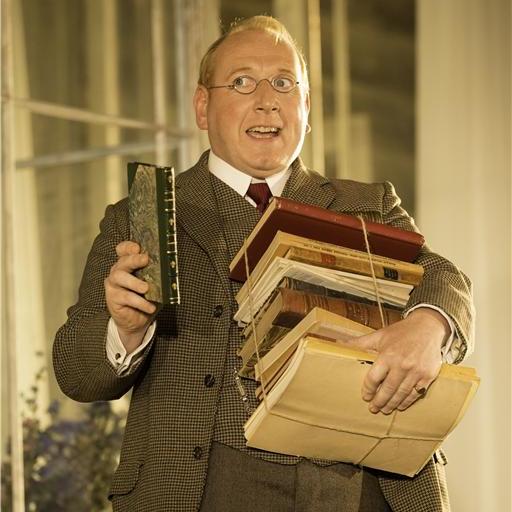
I envisage Tesman as middle aged, a little weary and quite bumbly. He is happy, yet oblivious, and Hedda means everything to him.
Cotume:
I would actually use a costume that is imilar to the picture. When he is going out or wearing daily clothes, he would be wearing a suit. It would be a bit battererd and obviously worn out as this would show how little money he has in comparison to Hedda. It would be in a brown or mustard colour as he simply cannot afford anything nicer. his trousers would be of the same colour, but perhaps a different shade, which further shows us his obliviousness and status.
When he was wearing nightclothes, i imagine him wearing a long dressing gown. This would be stained and worn yet again, as this is what he usually wears.
Sound:
I think that is you were putting on a more 'pantomine' version of the play, you could have a plodding, rythmic tune that marks his footsteps. However, if it was more serious, you could just have a more jolly tune that marks his entry.
Lighting:
Finally, I believe that his lighting would be rather like himself- it would be rather patchy in places yet still bright.
Monday, 28 November 2016
Pygmalion and Forum theatre.
 At the beginning of this lesson, we looked at this scene in Pygmalion. This scene is the opening section of the play and consist of a few characters trying to get away from the rain. The main character, the flower girl (Eliza), gets her flowers knocked over and because of this, argues with another character. She becomes increasingly aggravated with this gentleman and also argues with another man, who turns out to be friends with the first gentleman. In the end, she receives lots of money from the man and leaves in a taxi, however, she is still poor and her flowers are ruined.
We ran through this scene normally at first, then we took the scene and used forum theatre to explore how the outcome can change.
Firstly, James decided to see how the scene would change if Eliza never had her flowers knocked over by the man. This was actually not beneficial for Eliza as she gained a lot of money out of pity and not through selling her flowers. Therefore, if her flowers were not knocked over, she would not receive and more money, and her life will not change.
Then, we decided to work the scene if the bystanders and gentlemen were kinder to Eliza. We saw that the gentleman would offer Eliza a place to sleep straight away. However, Eliza was very wary about this prospect and decided not to go with the man. Therefore, nothing changed for her.
Overall, out of all of the changes we completed, the original scene actually appears to be the most beneficial to Eliza. However, it would have been interesting to observe how these slight changes would effect the entire play, and how this would effect Eliza and her life later on in the play.
Forum Theatre.
We decided to look at a new theatre type this lesson. This is a unique type of theatre that is developed by Brazilian practitioner Augusto Boal. Usually, the genre of his plays was some kind of oppression and Boal also used his technique- 'The rainbow of desire' heavily.
Boal decided to create a new kind of theatre in which the audience can participate within the action of the show.
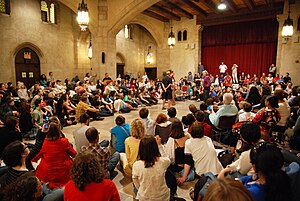
To do this, a play or scene would be shown two times to the audience and during the second version, the audience was encouraged to shout 'Stop' and take the place of one of the characters in the scene. This is used to observe how the situation can change and enable a different outcome in the end. These participants are called spect-actors and many different outcomes can be explored in one show.
The other actors remain in their role and improvise their responses. In order to smoothly enable communication between the actors and the audience, a facilitator (Joker) is needed.
This technique breaks the fourth wall between the performers and the actors which puts them on equal levels. It allows the audience to try out courses of action which are applicable to their daily lives. Originally, Boal developed the technique as a tool for political change, but it had been adapted and is widely used in educational contexts.
Boal decided to create a new kind of theatre in which the audience can participate within the action of the show.
To do this, a play or scene would be shown two times to the audience and during the second version, the audience was encouraged to shout 'Stop' and take the place of one of the characters in the scene. This is used to observe how the situation can change and enable a different outcome in the end. These participants are called spect-actors and many different outcomes can be explored in one show.
The other actors remain in their role and improvise their responses. In order to smoothly enable communication between the actors and the audience, a facilitator (Joker) is needed.
This technique breaks the fourth wall between the performers and the actors which puts them on equal levels. It allows the audience to try out courses of action which are applicable to their daily lives. Originally, Boal developed the technique as a tool for political change, but it had been adapted and is widely used in educational contexts.
Love and information- 'Grief'.
In this lesson, we each got into small groups. We were then told to choose one of the scenes out of a Love and Information. I teamed up with Fiona and we took the scene 'Grief':
I read the red lines, and Fio read the black ones:
Are you sleeping?
I wake up early, but that's all right in the summer.
Eating?
Oh enough. Don't fuss.
I've never had someone die.
I'm sorry, I've nothing to say.
Nothing seems very interesting.
He must have meant everything to you.
Maybe. We'll see.
After reading the scene through, we needed to think of three different ideas how we could perform the piece. These are our ideas:
1- We created a really detailed couple who appeared to be form a soap opera. The couple are actually divorces, and the wife has begun a new relationship with another man. This made the husband incredibly jealous, so he murdered the wives new boyfriend. She doesn't know of this, and when the husband attempts to console her over his death, she is confused yet happy. He is trying to make her fall back in love with him.
We decided to try and portray this by being very melodramatic and over the top. However, this was very hard to portray as we only had a short scene, so showing all this information was rather difficult.
2- Next, we decided to look into the scene in a slightly different way. To do this, we decided that the characters were young children (around 7 or 8). They were discussing the death of an imaginary friend. They are in a playground on the swing set. This was easier to portray as we just had to physicalize and vocalise a child, which would show the story.
3- Our final idea was that the person in red was a psychiatrist and the other person was somebody mourning their brother. The mourner was 18, and the psychiatrist was around 60. This was easy to interpret, as we simply created a physiatrist office with the staging, and then had one person lying in the chair and the other standing and speaking to them. This was okay to perform as it became obvious where they were. However, the psychiatrists lines became rather vague. They say "I'm sorry, I've nothing to say", and this is very unprofessional for a psychiatrist. This is why we decided that perhaps the psychiatrist was older. He was tired and close to retirement, which is why he wasn't doing very well in his job.
I read the red lines, and Fio read the black ones:
Are you sleeping?
I wake up early, but that's all right in the summer.
Eating?
Oh enough. Don't fuss.
I've never had someone die.
I'm sorry, I've nothing to say.
Nothing seems very interesting.
He must have meant everything to you.
Maybe. We'll see.
After reading the scene through, we needed to think of three different ideas how we could perform the piece. These are our ideas:
1- We created a really detailed couple who appeared to be form a soap opera. The couple are actually divorces, and the wife has begun a new relationship with another man. This made the husband incredibly jealous, so he murdered the wives new boyfriend. She doesn't know of this, and when the husband attempts to console her over his death, she is confused yet happy. He is trying to make her fall back in love with him.
We decided to try and portray this by being very melodramatic and over the top. However, this was very hard to portray as we only had a short scene, so showing all this information was rather difficult.
2- Next, we decided to look into the scene in a slightly different way. To do this, we decided that the characters were young children (around 7 or 8). They were discussing the death of an imaginary friend. They are in a playground on the swing set. This was easier to portray as we just had to physicalize and vocalise a child, which would show the story.
3- Our final idea was that the person in red was a psychiatrist and the other person was somebody mourning their brother. The mourner was 18, and the psychiatrist was around 60. This was easy to interpret, as we simply created a physiatrist office with the staging, and then had one person lying in the chair and the other standing and speaking to them. This was okay to perform as it became obvious where they were. However, the psychiatrists lines became rather vague. They say "I'm sorry, I've nothing to say", and this is very unprofessional for a psychiatrist. This is why we decided that perhaps the psychiatrist was older. He was tired and close to retirement, which is why he wasn't doing very well in his job.
Berkoff and the Glass menagerie.
During this lesson, we decided to take our previously studied practitioner and one of our possible texts. We took a particular scene from the play 'The Glass Menagerie' and attempted to make it Berkoffian in style. To do this, we broke off into pairs and edited our scenes. Me and Sam decided to do a scene where Amanda and Tom are eating dinner. The scene starts off with Amanda shouting at Tom for 'pushing' at his food with his fingers, and then descends into Tom retaliating and answering back towards Amanda.
To make this more Berkoff in style, we choreographed the eating at the beginning of the scene, and used the technique of robotic movements- they ate as if they were robots. This was particularly effective as it was visually interesting, yet also portrayed how the pair had become like clockwork.
Then Sam and I turned in sync towards the audience and performed certain lines towards them, in chorus. This is a mixture of Berkoff's techniques and was rather effective. Finally, we stood in sync and did a small choreographed section of movement. We made this unique as Sam was facing the audience, but I had my back to them, and turned away. I believe that this was effective as it showed how strained our relationship was.
To make this more Berkoff in style, we choreographed the eating at the beginning of the scene, and used the technique of robotic movements- they ate as if they were robots. This was particularly effective as it was visually interesting, yet also portrayed how the pair had become like clockwork.
Then Sam and I turned in sync towards the audience and performed certain lines towards them, in chorus. This is a mixture of Berkoff's techniques and was rather effective. Finally, we stood in sync and did a small choreographed section of movement. We made this unique as Sam was facing the audience, but I had my back to them, and turned away. I believe that this was effective as it showed how strained our relationship was.
Berkoff.
During this lesson, we decided to continue looking at Berkoff as a practitioner. We took this short section form hie play Metamorphosis:
"I liked hanging from the ceiling. It was better than the floor- one breaths more freely- and i can swing and rock backwards and forwards, forwards and backwards- i feel so light, and i can see the hospital across the street- all i can see from the floor is a drab, grey sky- i so much wanted to see my mother- it's so long since i have seen her- perhaps i am too hideous ever to see her again."

During this scene, the main character has been turned into a bug, presumably a cockroach. To portray this, we had three people at the top of a stack of set blocks and three entwined underneath them. The people who were sat on the staging were grotesquely placed, and all sat in similar positions. The people below were balancing inside the set, also in a similar position. During the performance, the people wt the top of the set had high pitched voices, and those at the bottom had lower pitched voices. This is a Berkoffian technique as he focuses on using varied pitch to portray character. We also had small sections of physicalisation throughout the piece, for example, for the line 'I feel so light', the three at the bottom of the staging got out and did a light to portray the feeling of lightness.
Overall, this incorporated with the range of pitches made the performance very effective as it was full of Berkoffian techniques.
"I liked hanging from the ceiling. It was better than the floor- one breaths more freely- and i can swing and rock backwards and forwards, forwards and backwards- i feel so light, and i can see the hospital across the street- all i can see from the floor is a drab, grey sky- i so much wanted to see my mother- it's so long since i have seen her- perhaps i am too hideous ever to see her again."

During this scene, the main character has been turned into a bug, presumably a cockroach. To portray this, we had three people at the top of a stack of set blocks and three entwined underneath them. The people who were sat on the staging were grotesquely placed, and all sat in similar positions. The people below were balancing inside the set, also in a similar position. During the performance, the people wt the top of the set had high pitched voices, and those at the bottom had lower pitched voices. This is a Berkoffian technique as he focuses on using varied pitch to portray character. We also had small sections of physicalisation throughout the piece, for example, for the line 'I feel so light', the three at the bottom of the staging got out and did a light to portray the feeling of lightness.
Overall, this incorporated with the range of pitches made the performance very effective as it was full of Berkoffian techniques.
Love and information short film.
During this lesson, we watched a short film interpretation of the script- 'Love and Information'. The film was quite good, but it only included these scenes:
- Sleep
- Secret
- Affair
- Fired
- Terminal
- God's voice
- God
- Maths
- Flashback
- Rash
- Shrink
- Cold
- Decision
- Keys
- Wife
- Virtual
Were there any scenes that were particularly effective?
Overall, I think the most effective scene was 'Wife'. The scene is based around a couple, and the wife appears to be convincing the husband that she is still herself. He denies it and towards the end of the scene, she disappears and it shows us that all along, she was not real. I think this is effective as it leads us to think that the scene is an ordinary section of the play, however, it turns out that she is a figment of his imagination, and this leaves the audience shocked,and full of questions. It is never fully explained, so it gives the audience lots of questions to think about.
Also, I think that the scene- 'Cold' was quite effective. I think this because it was a unique interpretation of the short scene (the scene simply consists of 'someone sneezes'). It is set at a funeral and we see a row of mourners, all dressed in black. One of these people attempts to block a sneeze and then eventually sneezes. I like this interpretation as it shows how unique this scene can be made for each performance. It also shows how the sneeze is utterly human and that it can happen at any time.
Were there and scenes that were not particularly effective?
Overall, i believe the scene 'secret' was not very effective. The scene was set in a kitchen, with two friends. It ended with one of the friends telling the other a secret. The acting in this scene is rather lacking, and appears rather forced. The nature of the scene makes sense, however, the character whispers into the others ear, which is illogical as they are in an empty kitchen setting. It would make more sense for the line to be whispered if they were surrounding be people. Overall, this made the scene seem as if it wasn't thought through.
Absurdism.
During this lesson, we took a text from a play by the theatre company 'Frantic Assembly'. The scene we chose involved a woman sitting in a garden and recollecting all of her memories in this garden. It was an interesting text, but in order to develop it, we decided to change the genre, and make it absurdist in style. In order to do this, we had to take the piece and rewrite it, whilst including at least 30% of the original text. This is my edited monologue:
"This garden is the world.
The World is the garden.
Flowers, trees, potatoes, shed, grass, swings, bushes.
Everything that matters is here and happened here and was here and will be here and won't be here.
With Tom, my cousin? Who I kissed? Maybe
Does it count if it's your cousin? Second or first?
Did you know that if you cut the grass in the world, Stella McCrea vomits in the compost."
To perform it in an interesting way, my task was to change the way i spoke whilst performing. In order to do this, i had to speak frantically, as if i was unveiling a governmental secret.
Overall, i believe that this was an effective task as it further looked into absurdism as a topic and also helped me to see how hugely different my reinterpretations can be, even if they only include 30% of the text.
"This garden is the world.
The World is the garden.
Flowers, trees, potatoes, shed, grass, swings, bushes.
Everything that matters is here and happened here and was here and will be here and won't be here.
With Tom, my cousin? Who I kissed? Maybe
Does it count if it's your cousin? Second or first?
Did you know that if you cut the grass in the world, Stella McCrea vomits in the compost."
To perform it in an interesting way, my task was to change the way i spoke whilst performing. In order to do this, i had to speak frantically, as if i was unveiling a governmental secret.
Overall, i believe that this was an effective task as it further looked into absurdism as a topic and also helped me to see how hugely different my reinterpretations can be, even if they only include 30% of the text.
Subscribe to:
Posts (Atom)